The best bathroom mirror ideas start with the job the mirror has to do: make a small room feel bigger, give you proper light for grooming, hide storage, or act as the room’s main decoration. A mirror chosen for the wrong job — a tiny decorative round over a wide double vanity, or a plain frameless slab where you need storage — will disappoint no matter how good it looks in a photo. Below, the ideas are grouped by job, with the sizing, hanging-height and lighting rules that decide whether each one actually works in a real bathroom.
In short: for most bathrooms, a mirror slightly narrower than the vanity, hung so its centre sits around eye level, paired with light from the sides or from behind the glass, beats a larger mirror hung too high under a single ceiling light. The rest of this guide shows which shape and style delivers that result for your layout.
Start With the Job, Not the Shape
Competitor roundups mostly sort mirrors by shape — round, arch, rectangular — and stop there. That misses the real decision. Four jobs cover nearly every bathroom, and each one points to a different mirror:
Enlarge the room. You need reflective area and light bouncing, so go large, frameless or full-wall, and place it opposite or beside a window or light source where it can double the brightness.
Light your face. You need even, shadow-free light, so choose a backlit LED mirror or a plain mirror flanked by sconces. A mirror alone, however stylish, cannot fix bad lighting.
Hide the clutter. You need a mirrored cabinet, recessed if possible, so toiletries disappear behind the glass instead of crowding the counter.
Make a statement. You need a shape or frame with character — an arch, a bold brass frame, a vintage silhouette — in a room that is otherwise calm enough to let it stand out.
Most bathrooms need two of these jobs at once, which is why the strongest ideas below combine them: a backlit arch mirror enlarges and lights, a mirrored cabinet stores and reflects. Pick your primary job first, then let shape follow.
Sizing and Hanging Rules That Decide the Result
Before falling for a shape, check three measurements. First, width: as general guidance, a single mirror should be slightly narrower than the vanity below it — roughly a few inches in from each side — so it reads as part of the vanity unit rather than overwhelming it. A mirror wider than the vanity makes the whole wall feel top-heavy, while one much narrower looks lost.
Second, height: hang the mirror so its centre is around eye level for the people who use it most, typically with the bottom edge a few inches above the splashback or counter. Hanging it to line up with a tall cabinet or a window frame, rather than with faces, is the most common reason a new mirror feels wrong. In a shared bathroom, favour the taller user’s eye level slightly, and check the reflection from a standing position, not from a ladder.
Third, clearance: leave breathing room around the frame for sconces, taps and open cabinet doors. A mirror squeezed between two light fixtures, or one whose edge collides with a swinging medicine-cabinet door, will annoy you daily. Measure the full swing and the fixture projection before ordering, not after.
Backlit LED Mirrors That Replace the Overhead Light
A backlit LED mirror glows from behind the glass, throwing a soft halo onto the wall and even light onto the face without the harsh shadows of a single ceiling fixture. That is why backlit models dominate 2026 trend lists: they solve lighting and atmosphere in one purchase, and they suit dark or windowless bathrooms especially well, where there is no daylight for a plain mirror to bounce.
Look for adjustable colour temperature if you can — warm white around 2700–3000K flatters skin tones for everyday grooming, while a cooler setting helps with detailed tasks. A dimmer matters just as much: full brightness for mornings, low glow for evenings. Check whether the model needs a wired connection or plugs in, because a hardwired LED mirror in a rented bathroom can become a project rather than an upgrade. And be realistic about demister pads: they help the centre of the mirror clear faster after a hot shower, but they do not stop the whole surface fogging in a steamy, unventilated room — ventilation still does the heavy lifting.
Arch Mirrors That Soften a Boxy Bathroom
Bathrooms are full of straight lines — rectangular tiles, square vanities, straight shower screens — so an arch mirror instantly changes the room’s geometry. The curved top draws the eye upward, which makes low ceilings feel taller, and it softens a boxy vanity without needing any other change. That is why arch mirrors, in both framed and frameless LED versions, keep appearing at the top of current trend guides.
Arches work best where the rest of the room stays calm: plain tile, a simple vanity, one metal finish repeated in the taps. In a busy bathroom with patterned tile and ornate fixtures, an ornate arch frame can tip the wall into clutter. A slim brass or black arch frame suits most modern bathrooms, while a thick wood arch leans farmhouse and needs a wood vanity nearby to feel intentional rather than random.
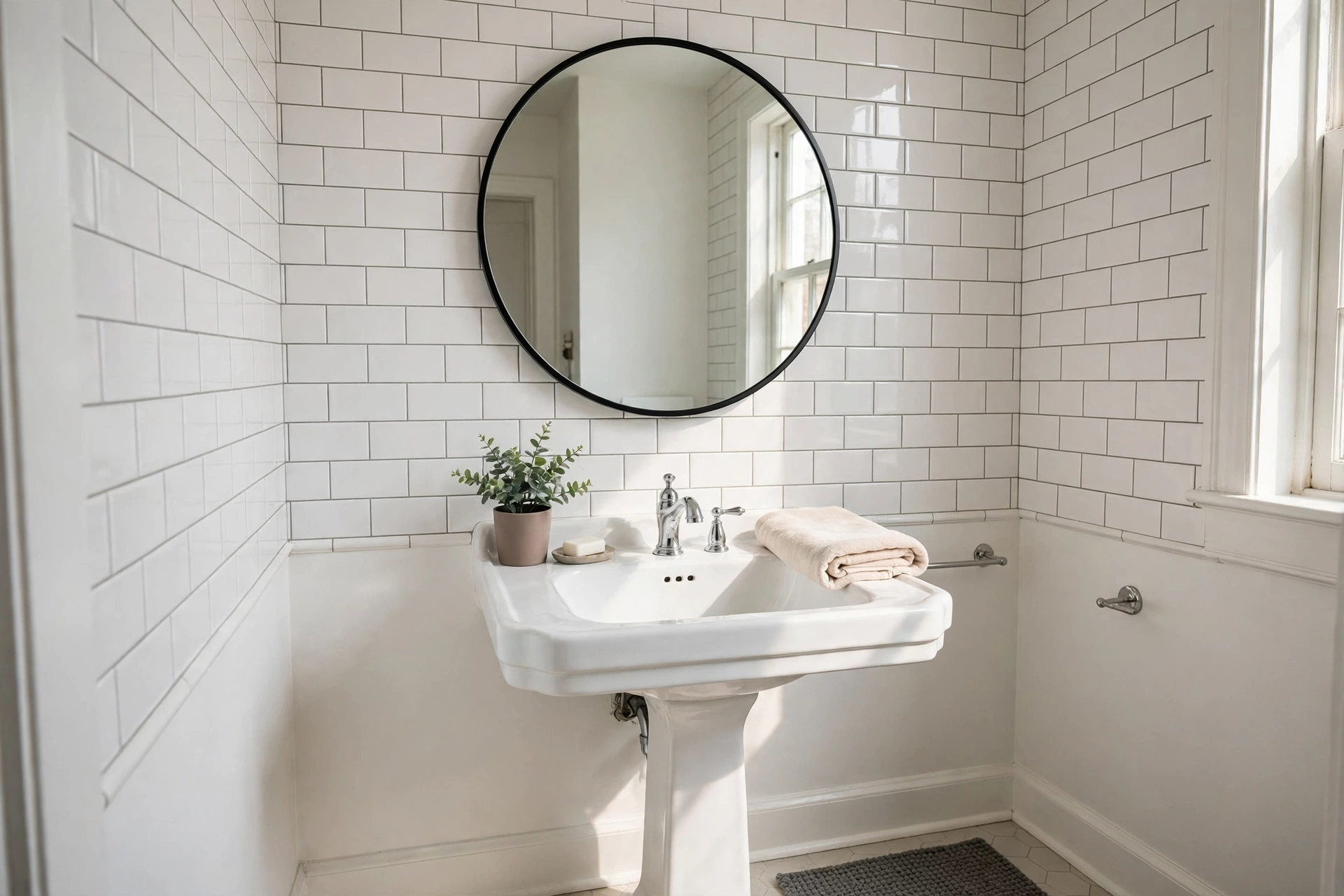
Round and Oval Mirrors for Small and Single-Sink Bathrooms
A round mirror is the safest choice for a small bathroom or a single pedestal sink, and competitor guides agree on why: the curve breaks up the hard angles of a boxy room, it needs no corners to align with the vanity, and it reads as decoration even when it is small. An oval does the same job with a vertical emphasis, which helps a narrow wall feel taller — a useful trick above a slim vanity in a powder room.
The trade-off is reflective area: a round mirror covers less of the wall than a rectangle of the same width, so it enlarges a room less than a full-wall or oversized rectangular mirror. If enlarging is your main job, go larger or pair two rounds — a clustered pair or trio of small mirrors can act as wall art while still reflecting light, though it will not replace a proper grooming mirror. For a single sink, one generous round, hung at eye level with a sconce pair or an LED halo, is usually the better grooming choice than a cluster.
Full-Wall and Oversized Mirrors for Light and Space
When a bathroom feels dark or cramped, no framed mirror beats sheer reflective area. A frameless panel running most of the vanity wall, or a full-wall mirror in a small bathroom, effectively erases that wall — the eye registers depth instead of surface. Frameless designs also suit minimalist bathrooms because there is no frame colour to clash with taps or tiles, and a polished edge keeps the look finished rather than raw.
The catch is maintenance and glare: a huge mirror shows every splash, toothpaste spot and fingerprint, and it can bounce a bright window straight into your eyes if placed opposite harsh sunlight. Keep the wall behind it simple, position it to reflect a light-coloured wall or a window at an angle rather than head-on, and accept a quick daily wipe as part of the deal. If the wall is busy — patterned tile, open shelving, a bold paint colour — a framed mirror that contains the reflection usually looks calmer than a wall of glass.
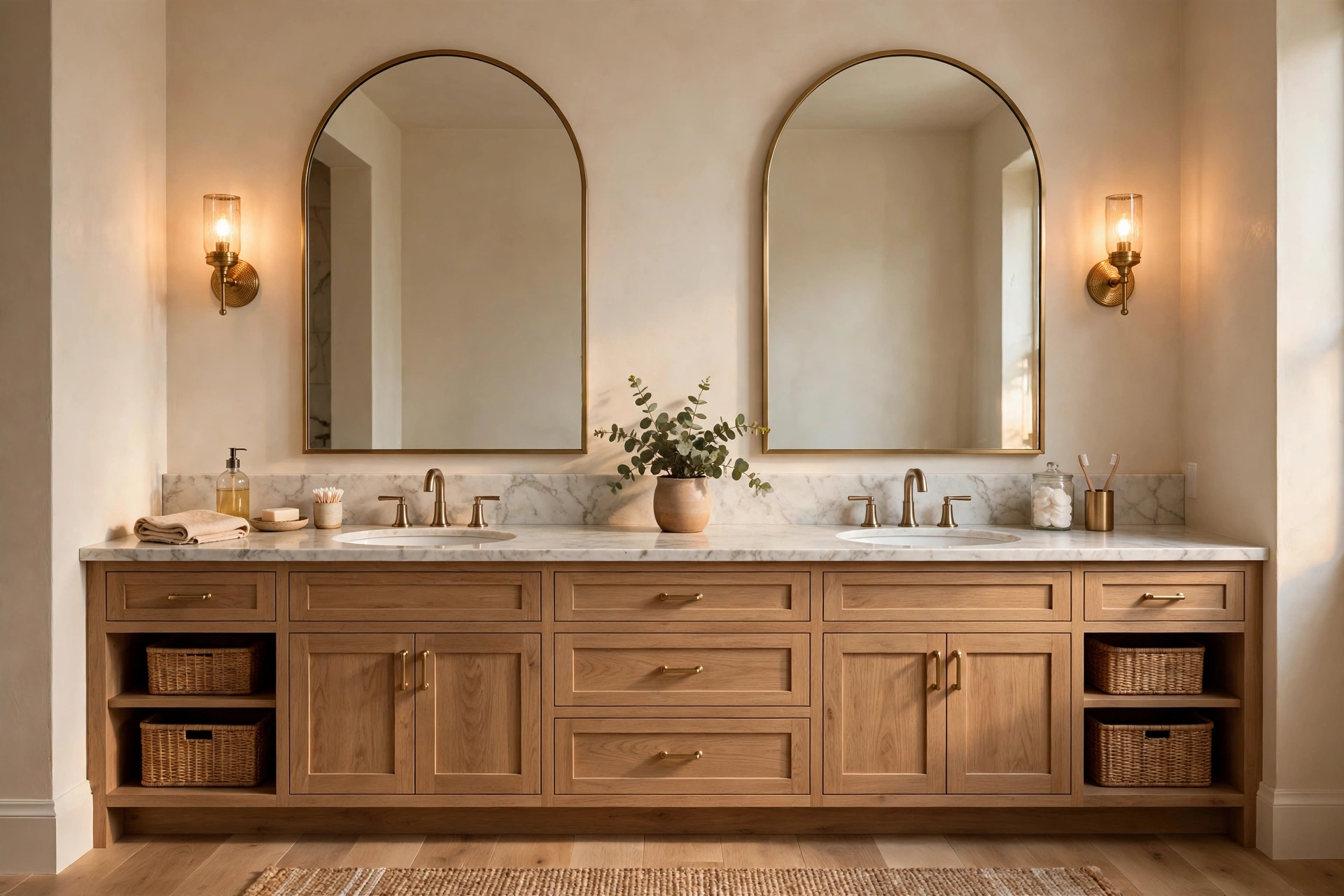
Double Mirrors for Double Vanities
Double vanities need one mirror per person — that rule, also used for sconce layouts, is the one competitor guides get most consistently right. Two matching mirrors, one centred over each sink, give each user their own grooming view and keep the long wall symmetrical. A single long mirror over a double vanity can work in a modern bathroom, but it merges two grooming zones and makes the wall feel like one commercial washroom rather than two personal spaces.
Where the mirrors sit close together, a shared sconce between them — one fixture in the middle and one at each outer end — saves wall space without leaving either side in shadow. Keep both mirrors identical in shape, size and frame: mismatched mirrors over a double vanity look like an accident, not a design choice. Our bathroom sconce light fixtures guide covers the spacing and heights for flanking pairs in detail.
Mirrored Cabinets That Hide the Clutter
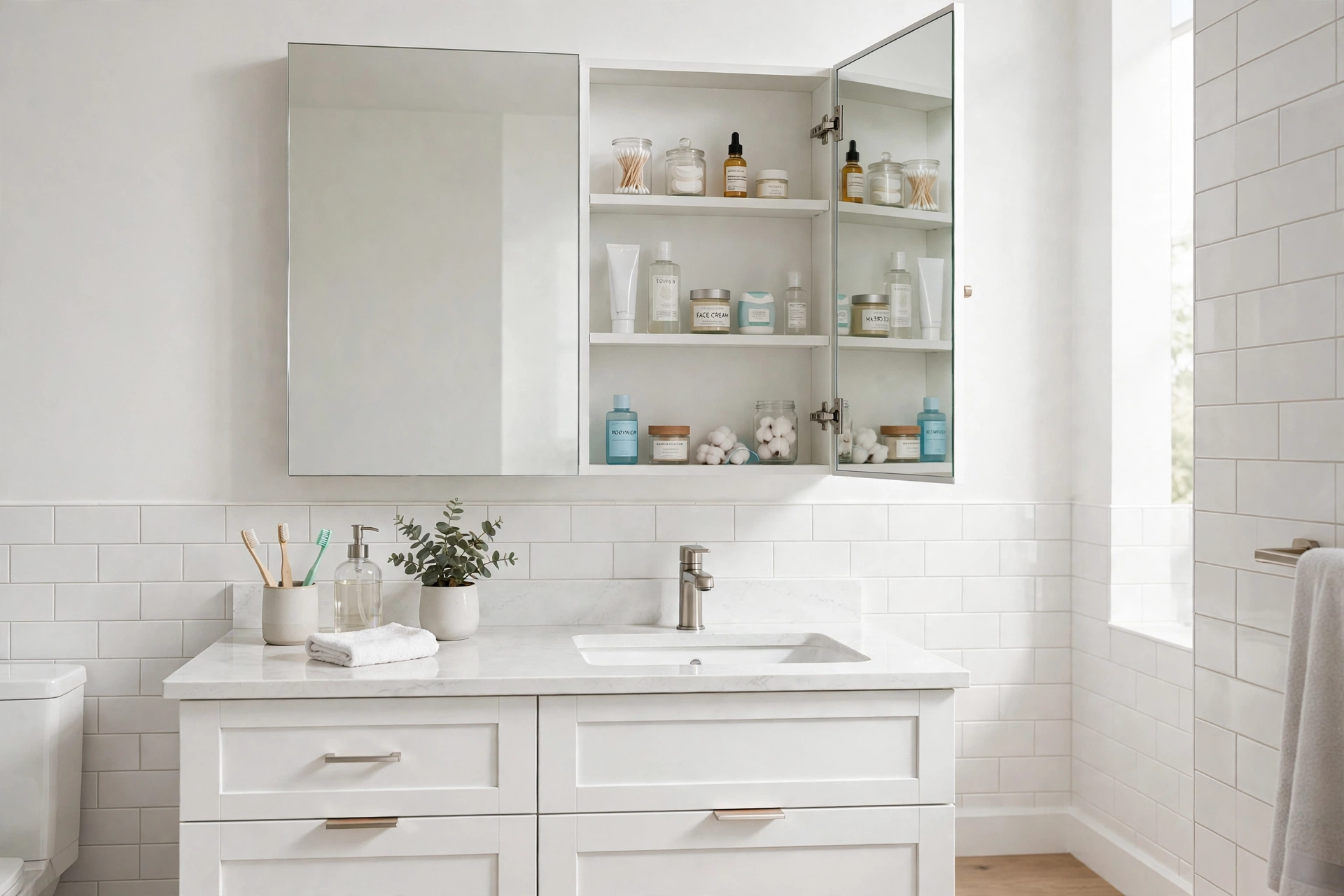
A mirrored cabinet is the only mirror idea that also solves storage, and in a small bathroom that double duty is often worth more than any shape. Recessed cabinets sit flush with the wall, so they add storage without jutting into the room — a surface-mounted cabinet that sticks out several inches can make a narrow bathroom feel tighter and can collide with tall users leaning over the sink.
Before choosing one, check the depth of your tallest bottles, whether the shelves adjust, and whether the door opens without hitting a sconce or a tap. A cabinet with a mirrored interior door is a small bonus for close-up tasks. If your bathroom already has good storage elsewhere, a plain mirror plus a separate cabinet — for example, the layouts in our bathroom cabinet storage ideas guide — may give you a cleaner mirror wall than forcing everything behind the glass. And if the vanity wall itself needs a refresh, our bathroom backsplash ideas show how the surface behind the mirror can carry the design.
Frameless, Vintage and Statement Mirrors
Frameless mirrors suit modern, minimalist bathrooms where the mirror should disappear into the wall. They are also the easiest to pair with any tap finish, since there is no frame metal to match — useful when taps, shower trim and cabinet handles already mix finishes.
At the other end, vintage and statement mirrors — a brass sunburst, an ornate gold frame, a reclaimed-wood frame — work as the room’s single piece of art. They suit powder rooms and guest bathrooms best, where the mirror is seen briefly and admired, rather than used for detailed grooming. In a main bathroom, keep the statement mirror’s frame finish matched to at least one other element, such as the taps or a light fixture, or it will look stranded. Wood frames need a sealed finish to survive bathroom humidity, and they should stay out of direct shower spray.
For rented bathrooms, leaning a large mirror against the wall, using a freestanding cheval-style mirror, or choosing a lightweight mirror on adhesive or no-drill fixings rated for its weight can give the look without drilling tile. Check the fixing’s weight rating and the wall surface first — adhesive fixings fail most often on textured tile and in steamy rooms, which is exactly where a falling mirror is most dangerous.
Lighting Pairings That Make or Break a Mirror
A mirror reflects whatever light you give it, so the pairing matters more than the mirror itself. Side light — a sconce on each side at eye level — is the most flattering grooming light because it fills shadows from both sides. An above-mirror bar suits tight walls where side space does not exist, but it throws light downward and can shadow the eyes if it is the only source. A backlit LED mirror replaces both, but it gives ambient glow rather than focused task light, so pairing it with a dimmable ceiling light for detail work is often the best of both.
Whatever the pairing, use warm white bulbs around 2700–3000K and a high colour-rendering index where possible, so skin tones read true. Frosted or opal shades diffuse the bulb and avoid mirror glare; clear glass with an exposed filament looks dramatic in photos and harsh in a mirror. If your bathroom includes a shower, the damp rating of any fixture near water matters — our tile shower ideas for small bathrooms cover surfaces that handle that moisture well.
Mistakes to Avoid Before You Buy
Hanging it too high. Lining the mirror up with a cabinet or window instead of with faces leaves shorter users looking at their foreheads.
Going too small over a wide vanity. A small decorative mirror over a 60-inch vanity looks lost and gives a cramped grooming view; size the mirror to the vanity, then choose the shape.
Ignoring glare and fog. A mirror opposite a bright window glares at eye level, and a plain mirror in a steamy, unventilated bathroom fogs regardless of price. Fix ventilation and placement first.
Mismatching finishes. A brass-framed mirror with chrome taps and black lights looks accidental. Repeat one metal finish at least twice on the wall.
Forgetting the door swing and sconce projection. Measure cabinet doors, sconce arms and tap clearance before ordering, especially with mirrored cabinets.
Choosing Checklist: Job, Size, Light, Finish
Run through four checks in order. First, job: enlarge, light, store or decorate — which one matters most in this bathroom? Second, size: slightly narrower than the vanity, centre around eye level, clearance for fixtures and doors. Third, light: side sconces, above-mirror bar or backlit LED, in warm white with a dimmer. Fourth, finish: one metal repeated across mirror frame, taps and lights, and a frame material that survives humidity where it will hang.
For more ideas in the same room, browse our Bathroom Decor guides — the mirror is one decision in a wall that also includes lighting, storage and the surface behind the sink, and choosing them together is what makes the result look designed rather than assembled.