Your shower caddy rusts because it lives where rust forms fastest: iron or steel, water, and oxygen together, day after day, with almost no chance to dry fully. Most caddies do not rust evenly across the bars — the damage starts at welds, screws, scratches, and spots where water pools, and those weak points decide whether a caddy lasts months or years.
That pattern is also good news. Once we know where the rust started, we can usually tell whether the caddy can be cleaned and saved, whether the material itself was the problem, or whether a habit — blocked drainage, a bleach cleaner, a bathroom that never airs out — is doing most of the damage. This guide works through that diagnosis first, then the fix, then the prevention routine that actually holds up in a real shower.
First, Find Where Your Rust Actually Started
Before reaching for vinegar or a replacement, look closely at where the orange-brown marks sit. The location is the best clue to the cause, and it changes the fix. Rust on a flat, undamaged bar points to a different problem than rust creeping out of a weld or a screw head.
| Where the rust sits | Most likely cause | What it means |
| At welds, corners, and joints | Heat-affected weld metal and crevices that trap water | The joint is the weak point, even on stainless caddies |
| Around screws, hooks, and brackets | Fasteners made from a cheaper or different metal | The caddy body may be fine; the hardware is failing first |
| Under bottles, on flat shelves | Standing water and soap residue that never drains | Drainage and placement are the problem, not just the metal |
| Where chrome is scratched or peeling | Plating breached, exposing the steel underneath | Expect spreading rust; cleaning alone rarely stops it |
| Where the caddy touches the wall or tub | Trapped moisture at a contact point | Move or remount it so air can reach that spot |
Pay special attention to joints that carry weight. A rusted hook or a corroded bracket is not only a stain — if the joint feels loose, wobbly, or sharp, stop loading it with heavy bottles until it has been checked. The same check applies to suction mounts that keep slipping: a mount that never dries out and never holds firmly is often fighting the same trapped-moisture problem.
The Three Ingredients — and Why a Shower Supplies All Three
Rust is iron oxide, formed when iron in steel reacts with oxygen in the presence of water. Remove any one of those three and rust stalls. A shower defeats that logic because it supplies all three continuously: direct spray, splashes, and steam keep the metal wet, air supplies the oxygen, and the caddy rarely gets a long, fully dry stretch between showers — especially in a bathroom with weak ventilation or several showers a day.
Temperature swings make it worse. Hot showers followed by cooler air stress coatings and open microscopic cracks at joints and edges, giving water and oxygen entry points that were not there when the caddy was new. That is why a caddy can look perfect for months and then seem to rust suddenly: the protective layer failed at a few small points first, and the damage spread from there.
Why Even a “Stainless Steel” Caddy Can Rust
Stainless steel earns its name from chromium, which forms a thin, self-repairing passive layer on the surface. That layer is strong, but it is not invincible, and not all stainless steel is the same. Lower grades, such as 201, resist corrosion less well than 304, while 316 adds molybdenum for extra resistance to chlorides in tap water and cleaning products. A listing that just says “stainless steel” without a grade tells us very little about how it will behave in a shower.
Four stainless-specific failures show up again and again. First, welds: the metal at a weld can behave differently from the surrounding bars, and poor welding leaves crevices where water sits. Second, fasteners: a 304 body held together with plain steel screws will rust at the screws first. Third, chlorides: bleach cleaners and harsh chlorine-based products can attack the passive layer, which is why bleach is a poor choice on a metal caddy even when it seems to clean well. Fourth, transferred iron: a rust-coloured speck that wipes or lightens easily may be iron deposited from another object — a razor, a bobby pin, a steel-wool pad — rather than corrosion of the caddy itself. Cleaning the source away matters more than scrubbing the caddy harder.
Why Chrome-Plated Caddies Rust First
Chrome plating is a thin, shiny coating over steel, not solid chrome all the way through. While the coating is intact, it is an effective barrier. Once it is scratched, chipped, or worn through — by a bottle dragged across it, an abrasive sponge, or years of cleaning — the steel underneath is exposed to water and oxygen, and rust starts exactly at that breach. Bubbling, flaking, or peeling chrome is the warning sign: the coating has already failed there, even if full rust has not appeared yet.
This is also why two chrome caddies can age so differently. A thick, well-applied coating on a caddy that is handled gently lasts far longer than a thin coating on a caddy that is scrubbed with abrasives. If the plating is already peeling across a shelf, cleaning will improve the look temporarily, but the exposed steel will keep rusting underneath unless the spot is sealed or the caddy is replaced.
The Five Accelerators Most Guides Skip
Material alone does not explain most rusty caddies. In practice, five habits and design flaws accelerate whatever weakness the metal already has, and fixing them often matters more than buying a more expensive replacement. The same standing moisture that rusts a caddy is also what draws ants in the bathroom.
1. Trapped Water and Blocked Drainage
Caddies rust fastest where water cannot escape: solid shelves with no drain holes, bottles sitting in a puddle of their own drips, and wire shelves packed so tightly that air cannot circulate. Check that drain holes are open and that bottles are not blocking them. A caddy that drains and dries between showers will outlast an identical one that holds a shallow pool all day.
2. A Film of Soap Scum
Soap residue and hard-water minerals form a film that traps moisture against the metal and stops it drying properly. That film also hides early rust, so by the time the orange shows through, the spot underneath is already established. A quick rinse and wipe does more than a deep clean once a month, because it never lets the film build up in the first place.
3. Hard Water, Chlorine, and Bleach Cleaners
Hard water leaves calcium and magnesium deposits that hold moisture and give rust a foothold, while chlorine in tap water and especially bleach-based cleaners can damage protective layers on stainless and chrome alike. Rinse the caddy with fresh water after cleaning, and keep bleach and harsh acidic cleaners off metal caddies. Mild, pH-neutral bathroom cleaners and a diluted vinegar rinse are far kinder to the finish.
4. A Bathroom That Never Dries Out
Poor ventilation is one of the strongest predictors of rust. If the mirror is still fogged long after a shower, the caddy is still wet too. Run the exhaust fan during and for at least 20–30 minutes after showers, open a window where possible, and keep the caddy out of the direct line of the showerhead if the layout allows. Placement alone — a few inches out of the main spray — can cut the hours the caddy spends wet each day.
5. Different Metals Touching Each Other
When two different metals stay wet together — a steel screw in a stainless frame, a chrome hook on a coated bar — corrosion can concentrate at the contact point. This is another reason rust so often starts at hardware rather than on open bars. When replacing screws or hooks, match the metal to the caddy where possible, and inspect wall-contact points and brackets during routine cleaning rather than waiting for orange stains to appear.
Is That Orange Mark Even Rust?
Not every orange mark on a caddy is rust, and the distinction changes the fix. Soap scum tinted by hard water, rust-coloured stains transferred from another metal object, and mineral deposits can all look similar at a glance. A useful test: if a mark lightens or wipes away with a vinegar-damp cloth and the metal underneath feels smooth, it may be a deposit or transferred iron. If the surface feels rough, pitted, or cratered, or the mark returns in exactly the same spot after cleaning, that points to real corrosion of the metal itself.
The same caution applies to stains the caddy leaves behind. Rust runoff can stain grout, tub enamel, and tile, so a caddy that is actively flaking should not sit in the same spot while the stain sets. Clean the surface underneath as well, and check whether the stain is on the tile or in the grout — surface stains usually lift, while grout that has absorbed rust may need a dedicated grout cleaner. For shower layouts where grout and tile take a beating, our small-bathroom tile shower ideas cover finishes that are easier to keep clean.
Can You Save It? Removing Rust by Severity
Light surface rust is usually worth tackling. Moderate rust takes more work and may leave a mark even after cleaning. Heavy rust — flaking, pitting, holes, or a weakened joint — is a replacement question, not a cleaning project. Matching the method to the severity protects the finish that is still intact.
For light rust, start with the gentlest option: soak a cloth in white vinegar, lay it on the spot for 20–30 minutes, then wipe and rinse thoroughly with fresh water and dry completely. A baking-soda paste (baking soda mixed with a little water to a thick consistency) left on the spot for a few hours, then scrubbed gently with a soft cloth or old toothbrush, works similarly for small areas. For slightly heavier surface rust on bare stainless, crumpled aluminium foil dampened with water or vinegar can lift rust without the deep scratches steel wool leaves — but test it first on a hidden spot, and never use it on a plated or coated finish you want to preserve.
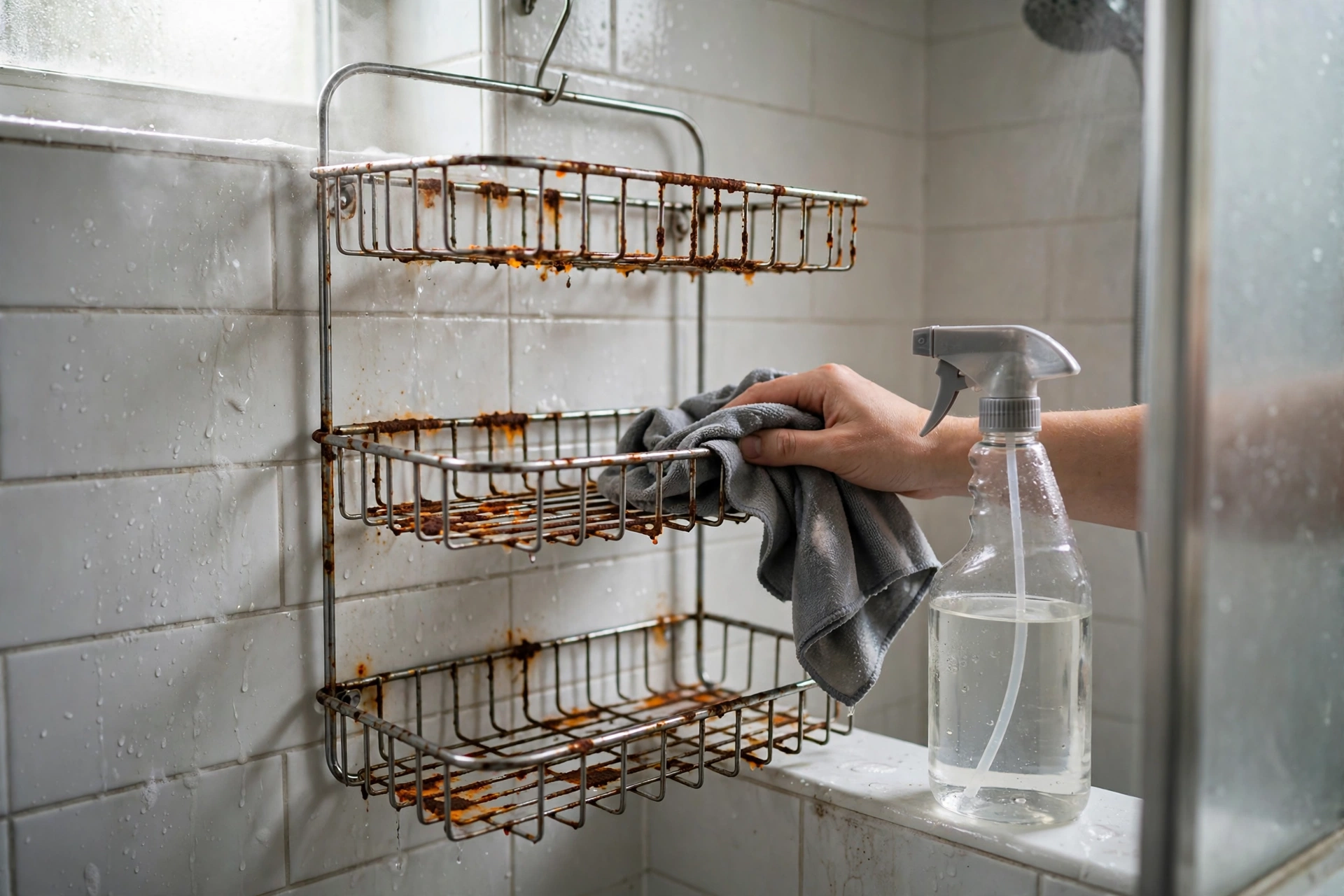
Whatever method is used, rinse well and dry fully afterwards — vinegar left on metal will keep working on it, which is not what we want once the rust is gone. A thin protective coat can help after cleaning: a light wipe of car or boat wax, or a clear rust-prevention spray made for metal, adds a water-repelling barrier. Treat coatings as a delay, not a cure: they wear off in a shower and need reapplying, and they will not save metal that is already pitted through.
What not to use matters as much as what to use. Steel wool sheds tiny iron particles that can rust in place and leave new orange specks, and it scratches chrome and coated finishes, opening fresh entry points. Bleach can damage stainless and chrome finishes and should be kept off metal caddies. Abrasive powders and scouring pads have the same drawback: they may remove the rust they can reach while damaging the protection around it.
The Prevention Routine That Actually Works
Prevention fails when it asks for too much effort. The routine below is built around one short habit after each shower and one slightly longer clean each week — enough to break the wet-film cycle without turning caddy care into a project. A damp shower corner that never dries is where smells start too; here is why a bathroom smells like sewage.
After each shower (about two minutes): shake loose water off the caddy, wipe the shelves and joints with a dry cloth or towel, and leave bottles standing so drain holes stay open. Run the fan for 20–30 minutes. That single drying step removes the long wet stretch that rust needs most.
Once a week: rinse the caddy with fresh water, wipe away soap scum with a mild cleaner or diluted vinegar solution, check welds, screws, and wall-contact points for early spots, and dry it again before putting bottles back. Catching a spot at this stage is a five-minute wipe; catching it a month later is a restoration job.
Once a season: inspect fasteners and brackets, tighten anything loose, and reapply a wax or rust-prevention coat if one is used. If a screw is already rusted, replace it with a matching-metal fastener rather than cleaning it and putting the same weak point back. Good drainage, a spot out of direct spray, and a bathroom that actually dries out will do more for the next caddy than any single cleaning product.
When to Throw It Away
Cleaning has limits, and keeping a failing caddy can cost more than replacing it — in stained grout, a dropped shelf of bottles, or a sharp edge. Replace the caddy if any of these apply: the metal is flaking, pitted through, or has holes; a load-bearing joint, hook, or bracket feels loose, wobbly, or bent; rust returns in the same spot within days of a thorough clean; the chrome is peeling across a whole shelf; or the caddy keeps staining the tub, tile, or grout underneath despite cleaning. A caddy that can no longer hold its rated load safely is finished, however good it looks from the front.
If You Replace It, Buy for the Weak Points
A replacement chosen only for looks will rust in the same places. Instead, check the points that failed last time: a stated stainless grade (304, or 316 for hard or chlorinated water) rather than an ungraded “stainless” claim, clean welds with no visible crevices, shelves that genuinely drain, fasteners in the same metal family as the body, and a mounting style that keeps the caddy out of constant direct spray. Aluminium and high-quality plastic caddies avoid rust altogether, trading some rigidity and premium feel for a material that cannot rust at all — a reasonable trade in a very humid bathroom or a rental where ventilation is poor.
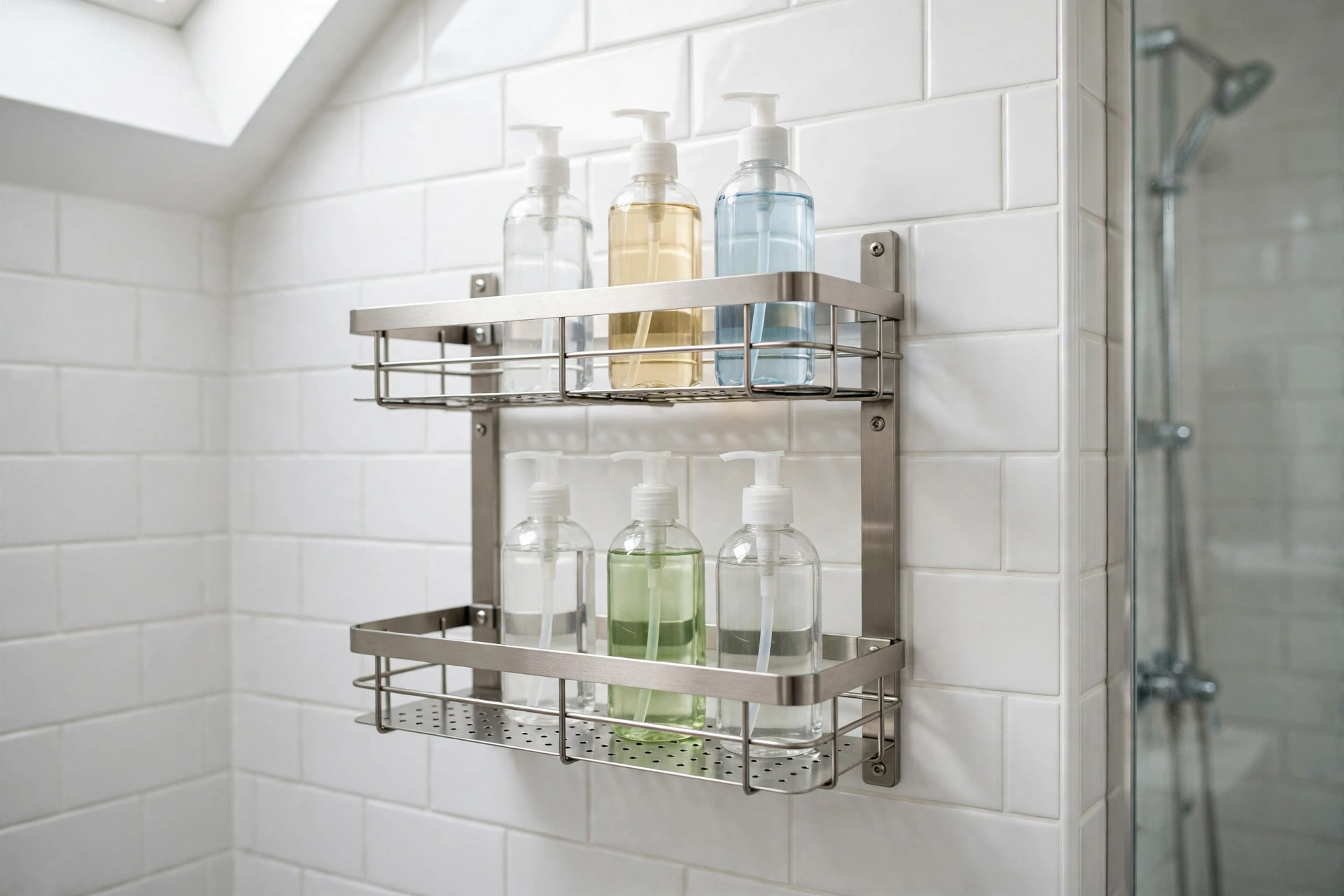
For a full comparison of rust-resistant designs, mounting styles, and capacities, see our best shower caddy guide, and browse the wider Shower Accessories archive for related shower storage ideas. The cheapest caddy that meets the checklist above will usually outlast a premium-looking one that hides an ungraded metal, blocked drainage, and mismatched screws.
Frequently Asked Questions
Most rusty caddies tell the same story once the location is checked: water that never fully dried, a coating or weld that gave way first, and a cleaning habit that arrived too late to matter. Dry the caddy, clear its drains, keep bleach off the metal, and check the joints weekly — and the next caddy will have a far better chance of staying the way it looked on the day it went up.