Four or five years ago, almost every hook I installed was chrome because that matched the faucet, the shower head, and basically every other fixture in a standard bathroom. These days, I’d say close to half my installs are matte black, and it’s rarely the client’s only black fixture. It’s usually part of a full switch, faucet, cabinet handles, light fixtures, and hooks, all moving away from shiny chrome toward something flatter and darker. I’ve watched this shift happen job by job, and I think it’s worth explaining why it happened, not just that it did.
It’s not really about the hooks, it’s about contrast
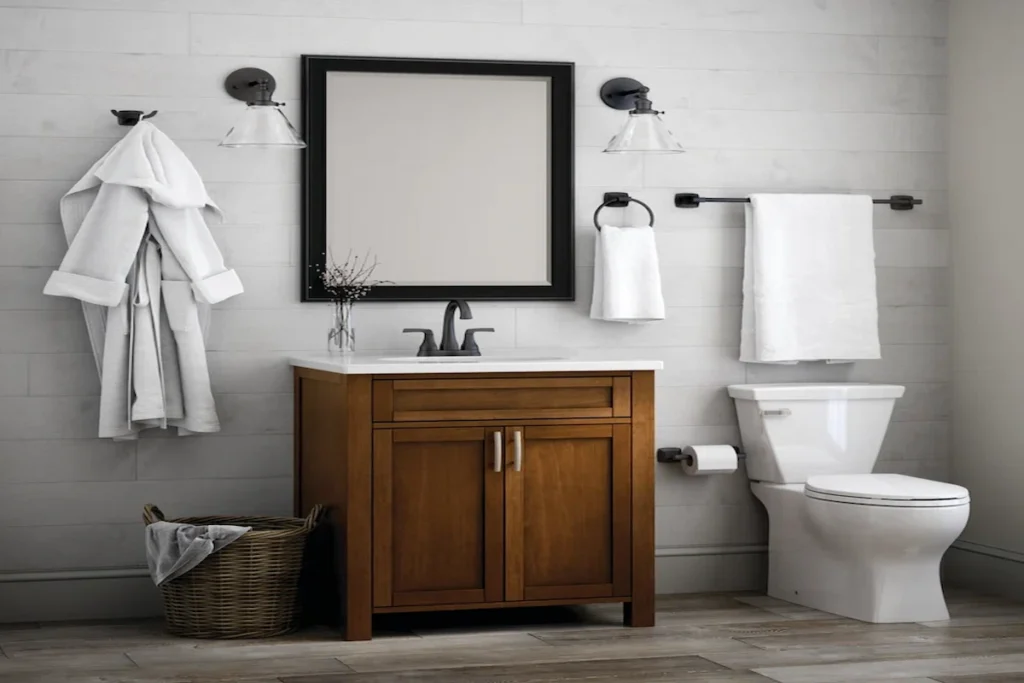
Chrome and polished nickel work by blending in. They’re reflective, they’re neutral, and they’re designed to disappear against white tile and a white sink. Matte black does the opposite. It stands out on purpose, which is exactly why it took off during a broader shift toward bathrooms that look more like a design choice than a default builder finish.
A single black hook on a white wall reads as intentional in a way a chrome one never quite does. Clients have told me, almost word for word, some version of “I want it to look like I chose it,” and black hardware does that immediately, even before you change anything else in the room.
Matte versus glossy black
Not all black finishes behave the same way, and this trips people up more than any other part of the decision.
Glossy black, essentially black chrome, reflects light and shows fingerprints and water spots almost as readily as regular chrome does. It looks sharp in a photo but needs wiping down constantly in real use, especially near a sink where hands are wet.
Matte black is coated to diffuse light rather than reflect it, which means it hides water spots and fingerprints far better day to day. It’s the finish I actually recommend for hooks specifically, since a hook gets touched constantly- wet hands, dry hands, robes being hung and pulled off multiple times a day.
Does the finish actually hold up in a humid bathroom?
This is the question I get asked constantly, and the honest answer is that it depends entirely on how the black coating was applied, not on the colour itself.
A cheap black hook is often just a thin spray-painted layer over base metal, and that layer chips at the edges within months, especially anywhere the hook gets bumped by a towel bar, door or dropped bottle. Once it chips, the exposed metal underneath rusts in a humid bathroom faster than the black coating would have worn on its own.
A properly finished black hook uses either a powder coat or an electroplated black finish over brass or stainless steel, which bonds to the metal rather than sitting on top of it like paint. That version resists chipping and actually improves with a slightly worn look over years rather than flaking.
When I’m comparing finishes for a client, I walk through exactly this kind of durability difference, alongside brass and chrome, in my article on brass vs chrome vs black bathroom hooks, since the underlying metal and coating process matters more than the colour you see on day one.
Where black hooks work best

Black pairs unusually well with warm tones, wood vanities, cream or beige tile, brass accents elsewhere in the room, because it acts as a grounding color rather than competing with everything else. I’ve installed black hooks in bathrooms with white subway tile and black grout lines, and the hook essentially echoes the grout, which pulls the whole room together in a way that’s hard to get with a reflective finish.
It also tends to work better in bathrooms with good natural light. In a dark, small bathroom with little window light, an all-matte-black scheme can read as heavier and smaller than it is, so I sometimes suggest keeping black to just the hooks and one other fixture, rather than going fully black on every piece of hardware, if the room itself is on the dim side.
Practical installation notes specific to black hooks
Black hooks show scratches from installation more visibly than chrome does, since a scratch through a matte black coating exposes bright metal underneath, which stands out immediately against the dark finish. I always use a cloth or tape over the jaw of any wrench or pliers when tightening a black hook, and I’d suggest the same at home, because a bare metal tool slipping even once leaves a mark you’ll notice every time you walk past it.
If you’re mounting into tile, mark your hole with painter’s tape rather than directly on the tile, both to protect the glaze and because a black screw head against white grout makes any drilling mistake far more visible than it would be with a chrome screw blending into white.
For exact mounting heights so your new black hooks actually function well, not just look good, my full breakdown is in how high to install bathroom hooks.
Black hooks in small bathrooms
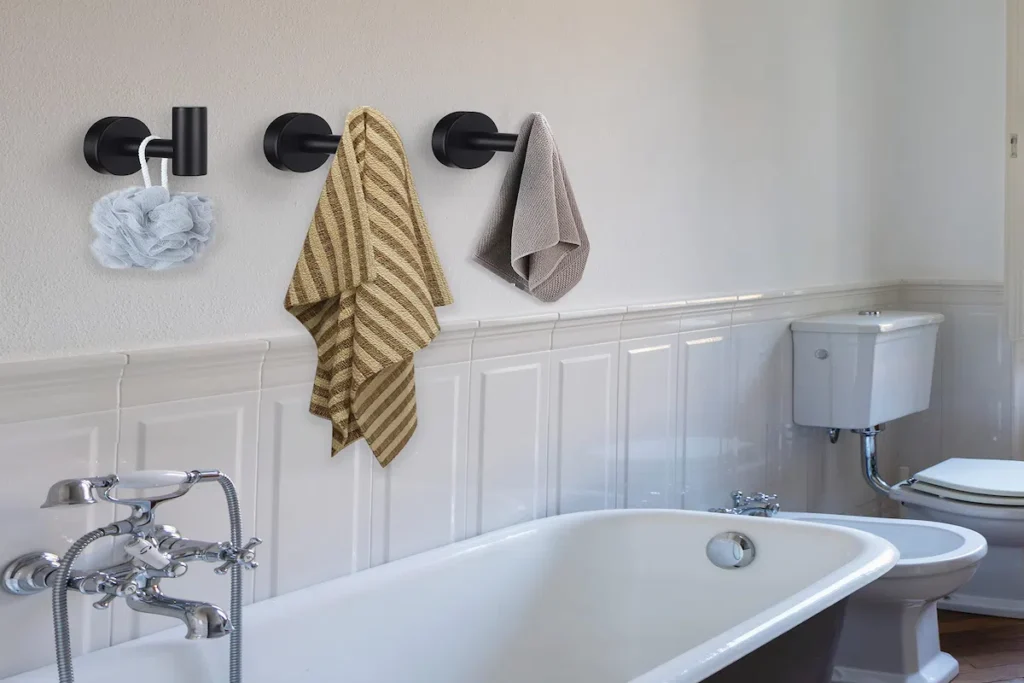
There’s a common assumption that dark hardware makes a small bathroom feel smaller, and it can, if you overdo it. Used sparingly, a couple of black hooks against a light wall, it actually helps a small space feel more considered rather than cramped, because it draws the eye to specific, deliberate points instead of leaving everything flat and matching. I go through exactly how to balance hardware choices in a tight layout in my guide to small bathroom hook ideas.
If you’re not ready to drill yet
If you like the look but you’re renting or not ready to commit to drilling into tile, matte black is now available in both adhesive and over-the-door styles, not just screw-in versions. I cover which adhesive options actually hold up under real shower steam in my adhesive towel hooks guide, and which over-the-door frames hold real weight without drilling in my over-the-door bathroom hooks article. Both now come in matte black finishes that look nearly identical to the screw-in versions.
Cleaning and caring for matte black hooks
Matte black hardware needs a slightly different cleaning approach than chrome. Abrasive sponges or anything with bleach can dull or lighten a matte coating over time, leaving faded patches that stand out against the rest of the hook. I recommend a soft microfiber cloth with plain warm water for regular cleaning, and a very mild, non-abrasive soap only when needed for heavier grime, like hard water spots that have built up around the base.
Avoid vinegar-based cleaners directly on black-coated hardware, even though vinegar is a common trick for hard water spots on chrome and glass, since the acidity can interact with certain powder coatings over repeated use and dull the finish faster than plain soap and water would.
How black hooks age compared to other finishes
One thing I tell clients honestly is that black hardware ages more visibly at contact points than chrome does, simply because any wear shows as a lighter mark against a dark background, whereas a scuff on chrome tends to blend into its own reflective surface. This isn’t necessarily a downside. Many clients specifically like that a black hook shows a bit of honest wear near the contact point after a few years, since it reads as lived-in rather than damaged, similar to how a well-used leather bag ages. If that’s not the look you want, buying the thickest, best-reviewed powder coat you can find and wiping the hook down regularly will keep it looking closer to new for far longer.
My honest take after installing hundreds of these
I don’t think matte black is a passing trend the way some finishes have been. It solves a real problem, chrome and nickel show water spots constantly in a wet room, and black genuinely hides that better while looking more deliberate on the wall. What I would caution against is buying the cheapest black hook you can find purely for the colour, since a thin coating over bare metal will chip and rust faster in a humid bathroom than a quality chrome hook would. Spend the extra few dollars for a proper powder-coated or plated finish, and it’s one of the easiest upgrades in the whole bathroom for how much visual difference it makes.
Frequently asked questions