The best natural stone bathroom hook is not the prettiest stone. It is the stone whose type, base and wall all match: a smooth pebble on a wooden backplate for a hand towel, a cut marble hook for a polished vanity wall, and a sealed, rough-textured stone kept away from delicate towels. When those three things match, a stone hook looks like part of the bathroom instead of a decoration stuck onto it, and it stays that way in daily steam and splashes.
We start with that match, because most stone-hook disappointment comes from choosing the stone first and the job second. A polished marble hook and a handmade river-pebble hook are both “natural stone,” but they behave differently, mount differently and need different care, and the guides and makers that sell them describe those differences in the same terms again and again.
Pick the Stone by Its Job First
Before choosing a stone, name the job. Is the hook holding a light hand towel by the sink, a heavy wet bath towel by the shower, or a robe that will stay there all day? Is the wall tile, painted drywall, or stone itself, and can it be drilled? This picker is the shortcut the research keeps returning to, and it decides which stones below will actually work in your bathroom.
| Stone | Best for | Watch out for |
| River or beach pebble | Hand towels, robes, spa-style bathrooms | Every piece is a different shape, so check the grip point |
| Cut marble | Polished vanity walls, classic bathrooms | Acidic cleaners etch it; needs sealing and gentle care |
| Granite | Busy family bathrooms, heavier towels | Heavier and harder to drill; check the fixing, not just the stone |
| Travertine or limestone | Warm, rustic shower and vanity walls | Porous and pitted; sealing matters more than the finish |
| Slate or sandstone | Textured, rustic looks | Rough surfaces can catch delicate towel fibres |
Two rules sit underneath the whole table. First, the stone is only half the hook: the base it sits on and the fixing behind it decide whether it holds, especially on tile. Second, variation is part of the product with natural stone, not a defect in it — two pebble hooks from the same maker will not be identical, and a veined marble hook will not match a sample photograph exactly. For a wall-mounted alternative that suits heavy towels, see the best wall-mounted towel hooks.
The Stones You Will Actually Find
Search results for this topic are dominated by one kind of stone hook above all others: handmade pebble hooks, usually a single smooth stone on a wooden backplate, sold singly or in sets. Cut-stone hooks in marble, granite and travertine exist too, but they are far less common as standalone bathroom hooks, and that difference shapes everything that follows.

River and Beach Pebbles
Pebble hooks are the most common natural stone hooks, and the most honest about what they are: a smooth, hand-selected stone fixed to a hardwood backplate, often oak, with a small metal fixing behind it. Makers describe them as one-of-a-kind because no two stones share the same shape, colour or veining, and they sell them for towels, robes and spa-style bathrooms rather than for heavy loads. The smooth surface is the point here — a polished pebble will not snag a towel the way a rough rock would — so check that the stone is smooth all the way around, including the underside where the towel actually rests.
Pebble hooks suit hand towels and robes best. A single small pebble gives a towel one narrow grip point, so a heavy wet bath towel can slide or pull the towel into a bunch, while a hand towel or robe sits comfortably. They also pair naturally with the wooden hooks in our wooden hooks for the bathroom guide, since most pebble hooks are really a wood-and-stone combination, and the wood backplate is what spreads the load on the wall.
Cut Marble
Cut marble hooks are the luxury end of this topic: a shaped piece of marble, often white with grey veining, used as a single hook or a small knob on a vanity or shower wall. Marble looks best where the rest of the bathroom already uses marble, because a single marble hook on a plain tiled wall can look like a leftover rather than a choice. It is also the stone that needs the most care, which we cover in the sealing section below, so a marble hook suits a bathroom where someone is already prepared to look after stone surfaces.
Granite
Granite is harder and less reactive than marble, which makes it the more forgiving cut stone for a busy bathroom. It still needs a sound fixing, and because granite is heavy and hard, drilling it or the wall behind it is not a casual job — the fixing and the wall matter more than the stone itself. Where marble is chosen for its veining, granite is usually chosen for its speckled, hard-wearing surface, and it suits family bathrooms where hooks get daily, careless use.
Travertine and Limestone
Travertine and limestone bring warmth that marble and granite do not: honey and beige tones, visible pits and a matte, rustic surface. Those pits are the trade-off. A pitted stone holds water and soap residue in its hollows, so it needs sealing and drying more than a polished stone does, and a travertine hook in a shower will need more attention than the same hook by a sink. Buy travertine for its look, and budget the care that goes with it.
Slate and Sandstone
Slate and sandstone appear far less often as bathroom hooks, and for a practical reason: their rough, textured surfaces can catch and wear delicate towel fibres over time. They suit a rustic bathroom where the hook is mostly decorative or holds a robe rather than a good bath towel, and they should be checked by hand before buying — run a cloth over the stone and see whether it snags. If it snags cloth, it will snag towels.
What Stone Changes About a Hook
Stone changes a hook in four ways that metal and wood hooks do not. First, weight: a stone hook is heavier than the towel it holds, so the wall fixing carries both, and a hook that would be fine screwed into drywall may need a proper anchor on tile. Second, grip: a smooth stone gives a towel one curved contact point, not a flat bar, so towels hang differently — compare this with the bar-versus-hook trade-off in our towel hooks vs towel bars comparison, where the same hanging-shape question decides how fast a towel dries.
Third, rust: the stone itself does not rust, but the fixing behind it can. Makers of pebble hooks point to stainless fixings and aluminium bases for damp rooms for exactly this reason, so check what the metal parts are made of rather than assuming the whole hook is rust-proof. Fourth, variation: no two natural stones match, so a row of stone hooks will look deliberately varied rather than uniform. That is the appeal for spa and rustic bathrooms, and a drawback for a bathroom that needs a perfectly matched set.
Mounting on Tile and Stone Walls Without Cracking
Mounting is where stone hooks most often go wrong, and it splits into two cases: mounting a stone hook onto a wall, and mounting any hook onto a stone wall. Both need more care than mounting on drywall, because tile and stone crack instead of giving way.
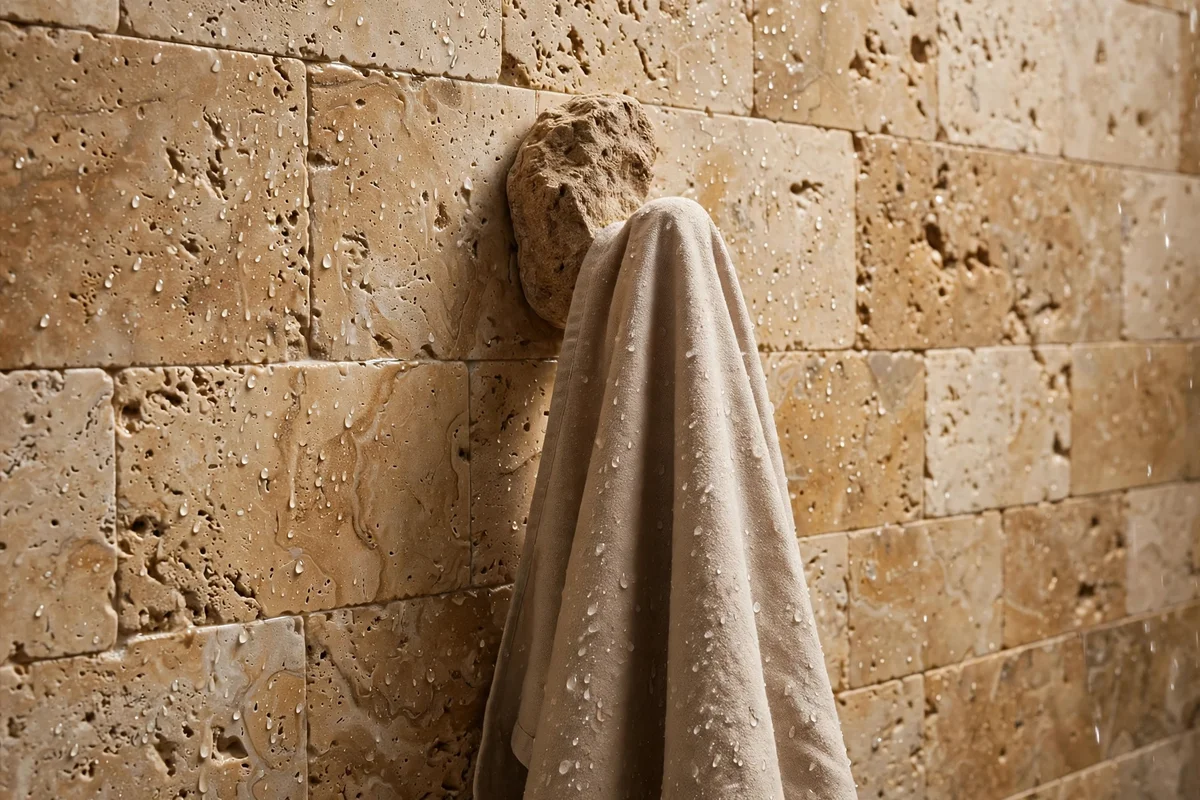
For a no-drill route, adhesive and suction options work only on smooth, clean, dry surfaces, and only within the maker’s weight rating. Guides for hanging things on tile return to the same points: clean the surface first, let the adhesive cure for the full time the maker states — commonly a full day — before hanging anything, and do not trust suction on textured or pitted stone, where no seal can form. A pebble hook on a wooden backplate spreads its load better than a single stone knob stuck straight to tile, which is another reason the wood-backed style dominates the market.
For a drilled route, the grout line is the safest target on a tiled wall: grout is softer than tile, easier to patch, and a hole there is less visible if the hook ever moves. On stone tile itself, guides recommend a masonry or diamond-tipped bit, a slow start so the bit does not wander, and a scrap piece to practise on first. Never use a standard plastic anchor on glazed tile or natural stone on the assumption it will hold — hairline cracks from a wrong anchor only show up later, when temperature changes and daily loading have worked on them. If drilling a stone wall feels uncertain, a wood-backed hook mounted into the grout or a stud is the safer permanent route, and our hook height guide covers placement heights once the fixing is decided.
Sealing and Cleaning: What Stone Needs
Stone care divides cleanly by chemistry. Marble, travertine and limestone are calcium-based, so acidic cleaners — descalers, limescale removers and vinegar-based sprays — react with the stone itself and etch a polished surface. Granite is harder and less reactive, so its sealer is usually the weak point rather than the stone. The safe routine that stone-care guides repeat is the same for all of them: a soft cloth, plain water or a pH-neutral cleaner, applied to the cloth rather than the surface, with a short contact time, then a rinse and dry.

Sealing is not stain-proofing, it is stain-delaying: a sealer buys time to wipe a spill up before it soaks in. The simplest test is a splash of water on a hidden spot — if the stone darkens and stays dark, the sealer is worn and the stone is absorbing again. Polished stone is naturally less absorbent than honed or tumbled stone, so a polished marble hook may need less sealing than a honed travertine one, and a sealer maker’s or stonemason’s instructions beat any general guide for a specific stone. Spot-test every cleaner on a hidden patch first, and keep acidic bathroom cleaners away from stone hooks entirely rather than hoping a sealer will save them.
Matching Stone Hooks to Your Bathroom
A spa or minimal bathroom suits pebble hooks best: one or two smooth stones on oak backplates, spaced so each towel hangs free, with nothing else competing for attention. A rustic or coastal bathroom suits the same pebble hooks in larger, rougher form, or travertine hooks that echo a stone-tiled shower. A classic marble bathroom suits cut marble hooks that match the vanity stone, used sparingly — one by the sink and one by the shower is usually enough, since marble is a strong visual statement in small doses.
In a small bathroom, stone hooks earn their place by being compact: a single pebble hook fits a sliver of wall where a rail will not, and a row of three on one backplate gives a household one hook each without a long rail. Renters should lean toward the no-drill route or an over-door option — see our over-the-door towel hooks guide — because a drilled stone or tile wall is the hardest surface to restore when moving out.
When Stone Is the Wrong Choice
Stone is the wrong choice in four common cases. First, a single small pebble hook for a heavy wet bath towel that will be yanked off daily — the grip point and the fixing are both too small for that job. Second, a polished marble hook in a bathroom cleaned with acidic sprays, where etching is a matter of time rather than chance. Third, an uneven or heavily textured wall, where a flat backplate cannot sit flush and an adhesive fixing cannot seal. Fourth, a bathroom that needs a perfectly matched set at a low price — natural stone is varied and mostly handmade, so matching sets cost more and still vary.
In those cases, a metal or wooden hook in a stone-look finish gives the appearance without the weight, care or fixing problems, and the money saved buys a better fixing for the wall itself. Stone hooks are at their best when they are chosen for one specific wall and one specific towel, not as a default for the whole bathroom. For more hooks in the same material-first spirit, browse our Bathroom Hooks guides.