Most bathrooms need 5 to 8 wall hooks: one bath-towel hook per regular user, one hand-towel hook by the sink, one robe hook for each person who actually hangs a robe, and one spare hook for guests. A single person in a one-bathroom home usually lands at 3 to 4 hooks, while a shared family bathroom with four regular users lands at 6 to 8. The rest of this guide turns that rule into an exact count for your household, your bathroom type, and the wall space you actually have.
We built this count from the way competitors answer the question — and from what they leave out. Most articles stop at “one hook per person” and never say what to do about robes, guests, hand towels, or a wall that is only 36 inches wide. Those are exactly the details that decide whether your count works in a real bathroom, so each section below answers one of them.
The Quick Count Formula
Count four things, then add them up. Nothing else belongs in the total — decorative hooks with nothing to hang, and hooks in other rooms, only inflate the number and clutter the wall.
1. Bath-towel hooks: one per regular user. Every person who showers in this bathroom gets their own hook, because a shared hook means a damp towel and a daily argument about whose towel is whose. A towel left bunched on a shared hook also dries slowly, which is the fastest route to a musty towel.
2. Hand-towel hooks: one by the sink. Count one for a single sink and two for a double vanity, so hand towels stay near the tap instead of migrating to the bath-towel hooks. A ring or a small hook both fill this slot.
3. Robe hooks: only for people who hang a robe. Not everyone does, so do not automatically add one per person. Count one robe hook per regular robe wearer, placed near the shower or the door rather than mixed in with the towel row.
4. Guest spare: one hook. One spare covers an overnight guest, a fresh towel waiting for laundry day, or a swimsuit drying after a swim. Two spares only make sense in a dedicated guest bathroom.
| Household | Bath-towel hooks | Hand-towel hooks | Robe hooks | Guest spare | Total |
| Single person, one bath | 1 | 1 | 1 | 1 | 3–4 |
| Couple, ensuite | 2 | 1 | 1 | 1 | 4–6 |
| Family of 4, shared bath | 4 | 1 | 1 | 1 | 6–8 |
| Family of 4, robes for all | 4 | 1 | 2–3 | 1 | 8–10 |
The ranges allow for real bathrooms: a double vanity adds a hand-towel hook, and a household where only one person wears a robe drops a hook or two. If your total falls outside these ranges, the sections below explain why — usually a second bathroom, a kids’ row, or a wall too short for the rail you planned. Once you have your count, see the best wall-mounted towel hooks to match it to wall-mounted options.
Count by Bathroom Type
The same household needs a different count in each bathroom, because each room has a different job. Counting per room, rather than per house, is the step most guides skip — and the reason so many bathrooms end up with either a bare wall or hooks nobody uses.
| Bathroom type | Typical count | What the hooks hold |
| Powder room (no shower) | 1–2 | Hand towel, plus one spare for guests |
| Guest bathroom | 3–4 | Two bath towels, one hand towel, one spare |
| Ensuite (couple) | 4–6 | Two bath towels, one hand towel, one or two robes, one spare |
| Shared family bathroom | 6–8 | One bath towel per user, one hand towel, one robe hook, one spare |
| Kids’ bathroom | 4–6 | One bath towel per child at child height, one hand towel, one spare |
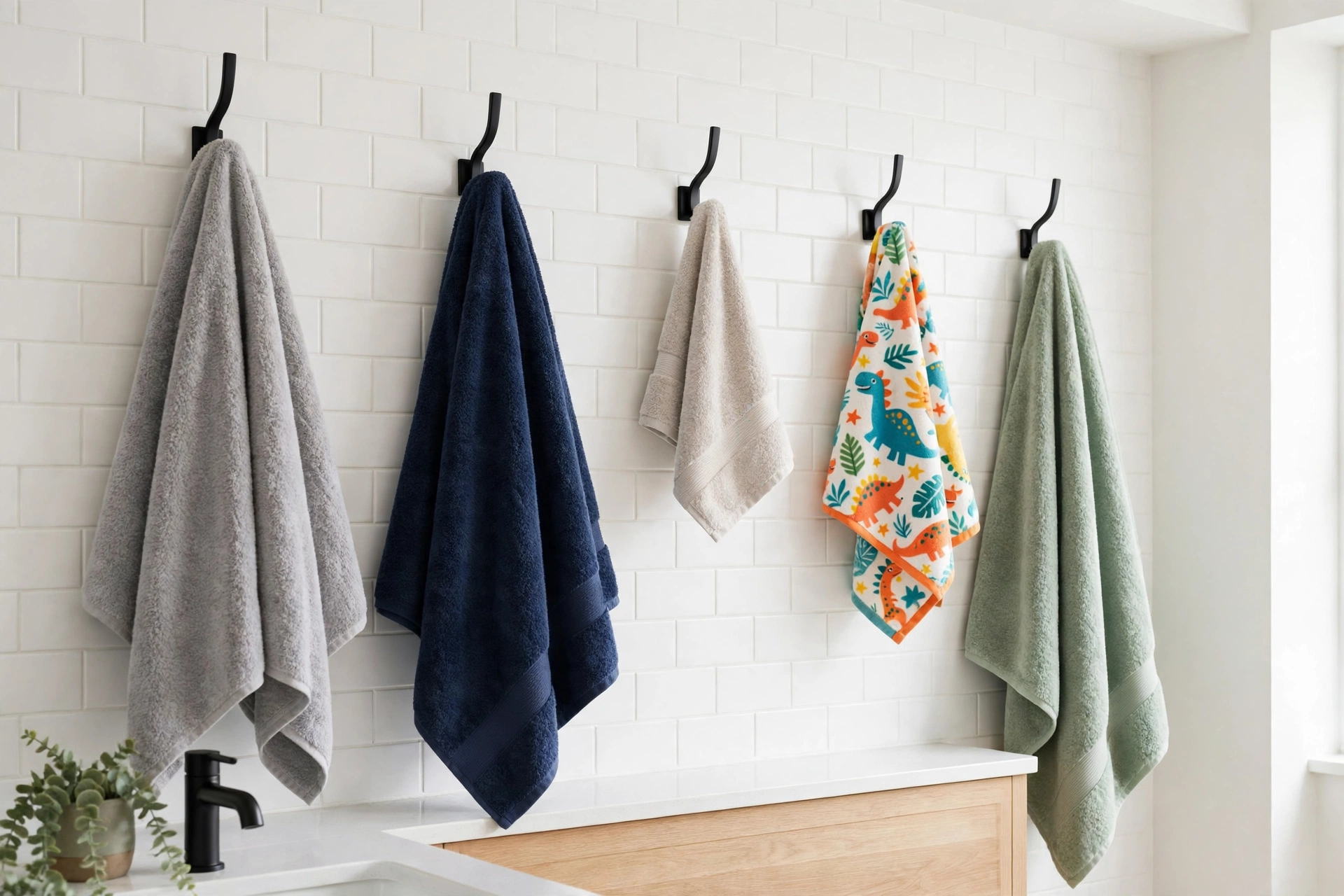
A powder room is the clearest case: with no shower, there is no bath towel to hang, so one hand-towel hook and one spare is the whole count. Adding a row of bath hooks there only creates hooks that stay empty. A guest bathroom sits at the other end of the same logic — guests need a bath towel each, but since guests rotate, two bath-towel hooks plus a hand towel and a spare cover almost every stay without overfitting the room.
In a kids’ bathroom, count the children, then add the hand towel and the spare — but mount the children’s row lower, at a height they can actually reach, rather than adding adult-height hooks they will never use. The count stays the same; only the placement changes.
What Counts as One Hook?
Not every hanging point equals one hook in this count. Getting this wrong is how a “6-hook” plan ends up holding only three towels, or a rail meant for four towels ends up crowded with six.
A single hook holds one towel. That is the baseline of the whole formula. A double hook — two prongs on one mount — holds two towels and counts as two slots, even though it takes the wall space of one mount. Our towel hooks vs towel bars comparison covers the trade-offs in full, but for counting purposes the rule is simple: count towels, not mounts.
A towel bar is not one hook. Roughly 10 to 12 inches of bar holds one bath towel comfortably, so a 24-inch bar counts as two slots and a 36-inch bar as three. If your bathroom already has a bar, subtract its slots from your hook count before buying anything — a family of four with a 24-inch bar needs four hooks, not six, because the bar already covers two towels.
A hook rail is a row of single hooks. A five-hook rail is five slots, no more and no less, provided the hooks are spaced far enough apart for towels to dry — which is exactly what the next section checks.
The Wall-Space Check: Will Your Count Fit?
A count that does not fit the wall is not a plan, it is a shopping list. Before buying, measure the wall run where the hooks will go and check it against the spacing towels actually need.
Space wall hooks 8 to 10 inches apart, centre to centre, so each towel hangs clear of its neighbour and air can circulate around it. Closer than that, towels overlap, stay damp, and the extra hooks add nothing but clutter. That spacing rule turns your count into a length: a row of five hooks at 9-inch spacing needs about 36 inches of clear wall between the first and last hook, plus a few inches of breathing room at each end — call it 42 inches in practice.
If the wall is shorter than the count needs, you have three honest options: split the row across two walls (for example, three hooks by the shower and two behind the door), switch some slots to double hooks, or let a towel bar carry part of the count. What does not work is squeezing the spacing below 8 inches — that defeats the drying that hooks are for. For the heights to pair with this spacing, our hook height guide gives the standard mounting heights for bath towels, robes, hand towels, and children’s rows.
Robe Hooks Are a Separate Count
Robe hooks earn their own line in the formula because robes behave differently from towels. A wet bathrobe is heavier and bulkier than a towel, it is usually grabbed right after a shower, and it is often hung in a different spot — on the back of the door or on the wall nearest the shower — rather than in the towel row.
Count one robe hook per person who wears a robe daily, and mount it where it gets used: within arm’s reach of the shower or on the door. If robes live in the bedroom instead, count zero robe hooks in the bathroom — the formula only counts what actually hangs in the room. Mixing robe hooks into the towel row also breaks the spacing rule, since a bulky robe swallows the airflow of the towels beside it.
Small Bathrooms and Renters: Fewer Hooks, Smarter Spots
Small bathrooms do not need a smaller formula — they need the same count fitted into fewer walls. A single person in a small bathroom still needs a bath towel, a hand towel, and a spare, which is 3 to 4 hooks; the difference is where those hooks go.
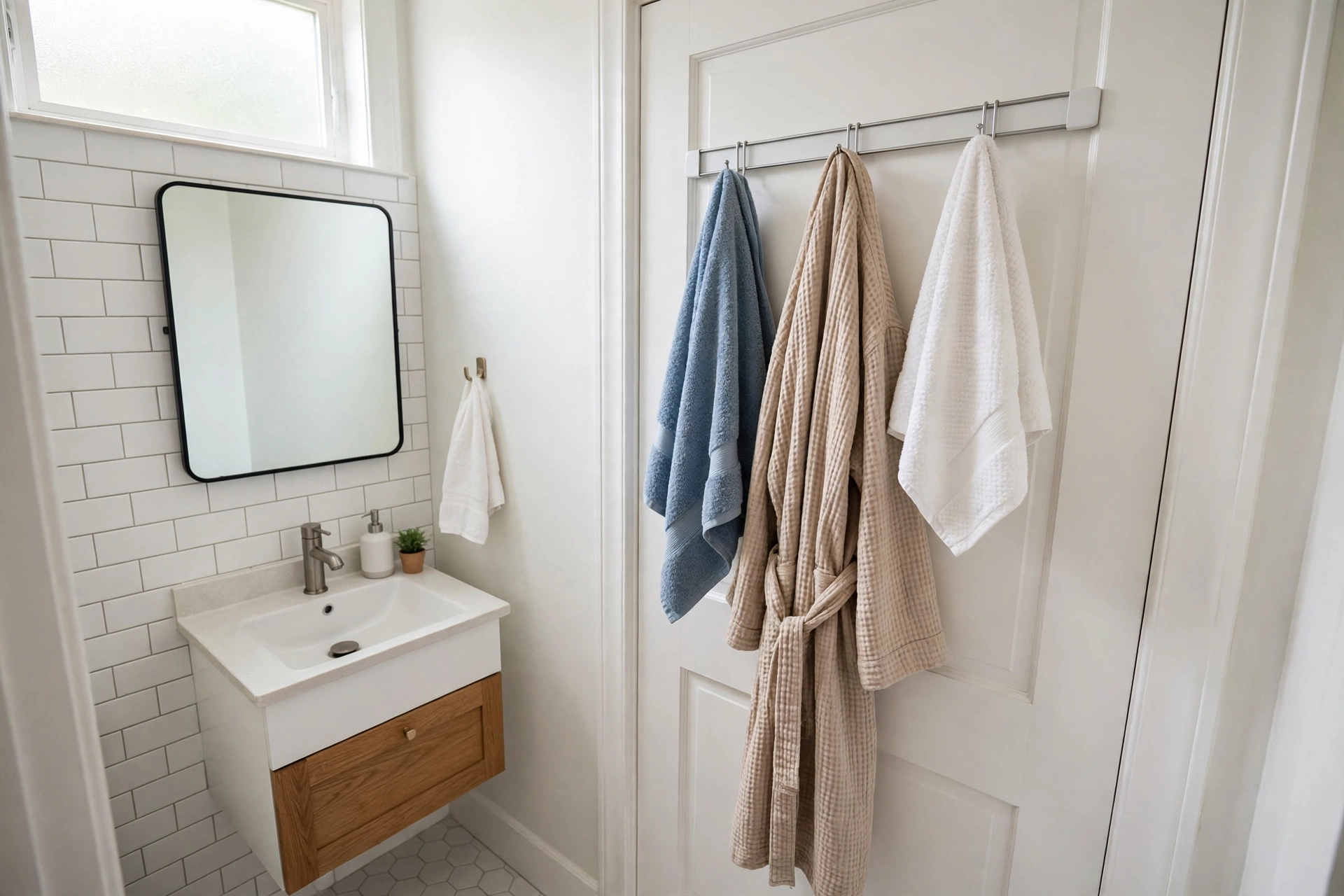
The back of the door is the highest-value spot in a small bathroom: an over-the-door rail adds three to five slots without touching the wall at all. The wall beside the sink takes the hand-towel hook, and one hook near the shower covers the bath towel. That is a complete small-bathroom count in three locations, with no rail long enough to overwhelm the room.
Renters face the same arithmetic with one extra constraint: no drilling. Adhesive and over-the-door hooks fill the same slots as screwed-in hooks, but the count should stay conservative — a no-drill hook holding a heavy wet bath towel every day is working harder than a screwed-in one, so check the weight rating before assigning it a bath towel. Our adhesive hook weight guide covers what these hooks genuinely hold on tile, glass, and painted walls. And if a count ever needs revising after the hooks are up, our adhesive hook removal guide shows how to move one without peeling paint.
How Many Is Too Many?
There is a ceiling, and crossing it makes the bathroom worse, not better. Watch for these signs that the count has gone too far: towels overlap because spacing dropped below 8 inches; hooks sit empty for weeks, which means they were counted for people or towels that do not exist; the wall looks like hardware rather than a bathroom; or hooks multiply across every wall instead of grouping where towels actually get used.
The fix is almost always subtraction, not rearrangement. Remove the hooks that have held nothing for a month, starting with the ones farthest from the shower and the sink — those are the slots the household voted against with its feet. A bathroom with six well-used hooks beats one with twelve hooks and four damp towels every time.
Shower Curtain Rings Are a Different Count
One confusion is worth clearing up, because search results mix two different products under the word “hooks.” Wall hooks are counted by people, as this guide does. Shower curtain rings are counted by the curtain: a standard 72-inch curtain has 12 grommets and needs 12 rings, spaced roughly 6 inches apart, and wider curtains need proportionally more. If you searched for a curtain count, that 12-ring rule is your answer — and it has nothing to do with how many wall hooks your bathroom needs.
Count Checklist Before You Buy
Run through this list once, and the count is settled: regular users counted, one bath-towel hook each; hand-towel hook by each sink; robe hooks only for robe wearers; one guest spare; towel-bar slots subtracted; wall length checked at 8 to 10 inches per hook; door rail counted for small bathrooms and rentals. If every line checks out, buy that number — and no more.
Still deciding between hooks and bars for part of the count? Browse the full How-To Guides archive for placement, spacing, and removal guides that pair with this count.