Hanging a towel on a hook sounds simple, yet it is the difference between a towel that is fresh the next morning and one that still feels damp and smells musty. The short answer is this: shake the towel out, fold it lengthwise, loop it over the hook so the fabric hangs as open and loose as possible, and give it its own hook with clear air around it. When a towel is bunched up, stacked on another towel, or left behind a closed door, the folds in the middle stay damp for hours, even if the outside feels dry.
We cover the full routine below: the step-by-step hanging method, where to put hooks, how high to hang them, how far apart to space them, how many hooks a bathroom needs, and the small drying habits that keep towels fresh between washes. Nothing here requires a new product — it is about using the hooks already on the wall well.
How to Hang a Bath Towel on a Hook, Step by Step
Start with a towel that has just been used, not one pulled straight from a laundry pile. The goal at every step is the same: keep the fabric as open as possible and let air reach both sides.
- Shake it out. Give the towel a quick shake before hanging it. Shaking straightens the fabric and stops damp fibres clumping together, which is what blocks airflow.
- Fold it lengthwise, once. Fold the towel in half lengthwise, or in thirds lengthwise for a neater, slimmer drape. Folding lengthwise keeps the towel narrow enough for a hook while leaving the two sides hanging free, rather than pressed together in a ball.
- Loop it over the hook, not around it. Drape the folded towel over the hook so both ends hang at roughly the same length. Do not twist it around the hook or scrunch it into a knot — twisting compresses the pile and traps moisture in the thickest part.
- Spread the fabric out. Fan the hanging towel open with your hands so the layers are not lying flat against each other. The towel should hang loosely, with a little space between the fabric and the wall.
- Check the drop. The bottom of the towel should clear the floor, and the towel should not be resting on a countertop, toilet tank, or another towel. If it touches anything below it, the contact point stays damp.
One useful variation, recommended in our own hooks-versus-bars comparison, is hanging the towel by one corner instead of the middle. It spreads the towel out more and dries noticeably faster than a towel folded in half over the hook — a good trick for a thick bath sheet in a humid bathroom. For the full comparison of when hooks beat bars and when they do not, see our guide to towel hooks vs towel bars.
How to Hang Hand Towels, Washcloths, and Robes on Hooks
Different towels need slightly different handling, because a hand towel and a bath sheet do not hang the same way.
Hand towels
Fold a hand towel in thirds lengthwise, then drape it over the hook near the sink. A hand towel is used often and dries between uses only if it is not folded into a thick pad, so keep it thin and open rather than doubled over several times.
Washcloths
Hang a washcloth unfolded over its own small hook, or draped over the top of a hand towel only if it can still get air. A washcloth bunched into a corner of a hook is the item most likely to stay damp, so give it the same open treatment as a larger towel.
Robes
Hang a robe by its collar loop on a larger, curved robe hook rather than by a sleeve or belt. A robe needs more drop than a towel, so its hook should sit high enough that the hem clears the floor. If a robe and a towel share a hook, the robe goes on the hook first and the towel on top will only slow drying for both — give each its own hook where possible.
Where to Put Towel Hooks in the Bathroom
Placement matters as much as technique. A perfectly hung towel will still stay damp if it sits behind a closed door with no air movement, while a casually hung towel near a fan or an open doorway dries far better. Competitor guides and laundry experts agree on the same few principles.
- Beside the shower or tub, within arm’s reach. The most useful spot is the wall you naturally turn toward when stepping out, close enough that you are not dripping across the floor to reach the towel. Several guides put the first hook roughly within a step of the shower opening.
- Beside the vanity for hand towels. A hand towel hook belongs within one step of the sink, not across the room, so wet hands do not drip on the way to it.
- On an open wall, not behind a closed door. Damp towels left on hooks behind closed doors sit in still air and dry slowly. If the only spare wall is the back of the door, keep the door open after showering or run the exhaust fan so air keeps moving.
- Near airflow where possible. Wall space near a fan, vent, window, or doorway dries towels faster than a tight corner. Avoid spots where the towel will press against cold tile or sit directly in shower spray.
- In a small bathroom, use the walls you already have. Narrow strips beside a door frame, the side of a vanity cabinet, or a staggered pair of hooks on a short wall all work. A single row of three hooks beside the shower covers most families without needing a full bar.
For glass shower doors, the same placement logic applies, but the mounting changes — clamp-on and suction hooks are the no-drill options covered in our guide to towel hooks for glass shower doors. And if drilling is not an option anywhere in the bathroom, our guide to adhesive towel hooks covers the surface prep that decides whether they hold.
How High to Hang Towel Hooks and How Far Apart to Space Them
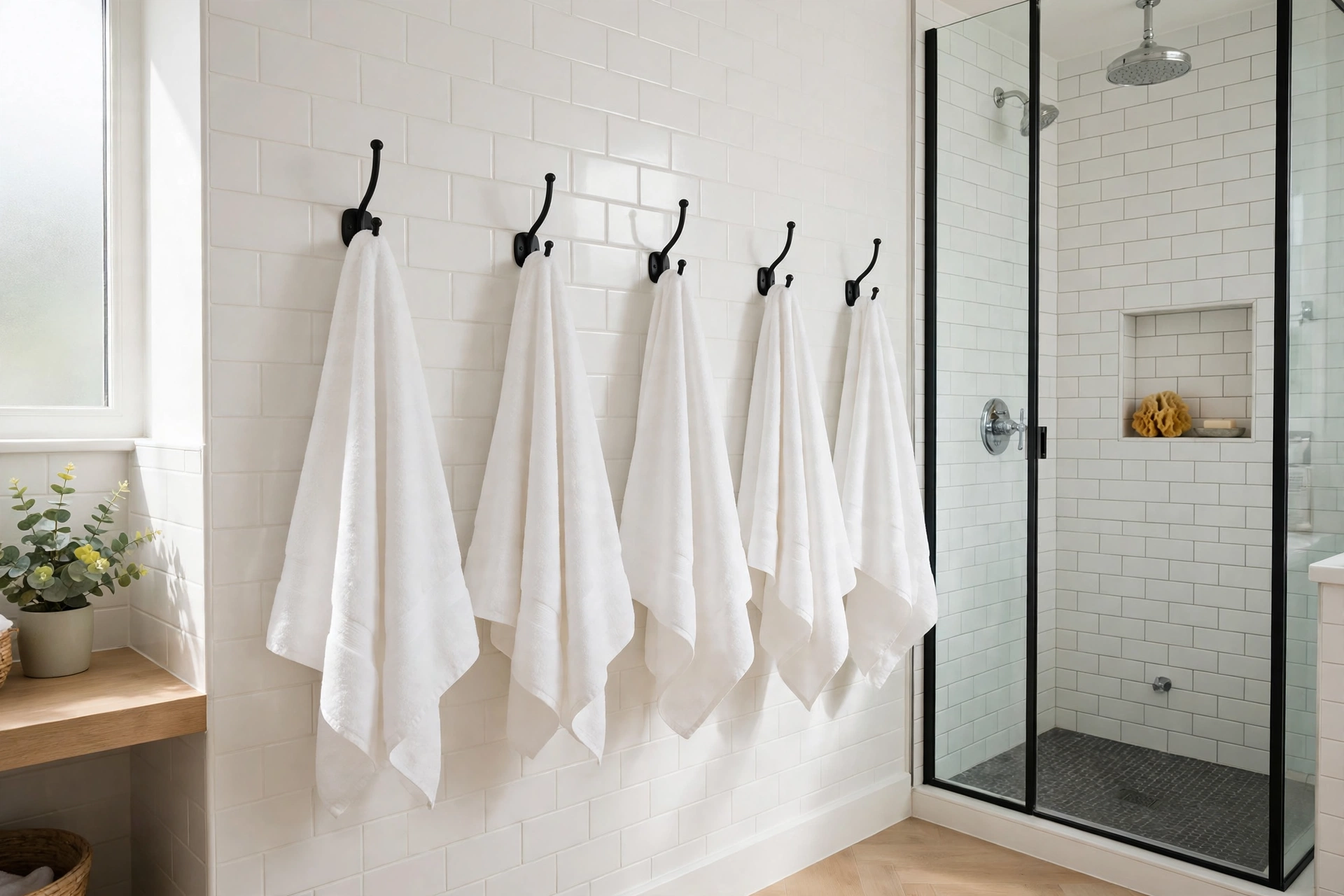
Published guidance varies a little by source, so treat these numbers as starting points and adjust for the household and the longest towel in use — not as fixed rules. The test that matters most is simple: hang the longest towel on the hook before deciding the height is right, and check that it clears the floor.
- Adults: most guides put bath towel and robe hooks at roughly 65 to 70 inches from the floor. That height lets a standard bath towel hang freely without touching the ground.
- Children: most guides put a lower row at roughly 40 to 48 inches, so children can reach their own hook without help. Staggered heights — one adult row, one lower row — work well in a shared family bathroom.
- Hand towels by the sink: hand towel hooks sit lower than bath towel hooks, roughly at or just above vanity height, within easy reach of the basin.
- Spacing between hooks: most guides recommend roughly 8 to 12 inches between hook centres. Closer than that, towels overlap and the touching layers stay damp; wider spacing is fine when wall space allows, but is not required.
- Distance from the shower: keep the first hook close enough to reach from the shower, but far enough that it is not sitting in direct spray.
Because sources differ — some put adult hooks a few inches lower, around 60 to 66 inches — the towel-drop test beats any single number. For a detailed breakdown by adults, children, and robes, see our guide on how high to install bathroom hooks.
How Many Towel Hooks Does a Bathroom Need?
The simplest rule, repeated across competitor guides, is one hook per person, plus one for a hand towel at the sink. A hook that carries two or three towels dries none of them properly, so adding hooks is almost always better than stacking towels. A bathroom towel bar holds more towels than hooks when wall space allows.
- One person: one bath towel hook near the shower, one hand towel hook near the sink.
- A couple: two bath towel hooks, spaced so the towels do not touch, plus a hand towel hook.
- A family bathroom: one hook per child at child height, plus adult hooks, so nobody drapes a towel over someone else’s. A row of three hooks beside the shower covers most families.
- A guest bathroom: one hook for the guest’s used towel, even if a bar holds the fresh display towels. Guests should not have to hunt for somewhere to hang a wet towel.
- Robes: count robes separately. A robe on a towel hook takes that hook out of use for towels, so add a dedicated robe hook near the shower if robes live in the bathroom.
Double hooks can help in a tight bathroom, giving two hanging points from one set of screw holes, but they only help if both towels still hang without touching. If two towels on a double hook press together, they dry no better than two towels on one hook.
How to Make Towels Dry Faster on Hooks
Hooks have one honest trade-off: a towel on a hook bunches more than a towel spread flat on a bar, so it dries more slowly. That does not make hooks a bad choice — it just means drying habits matter more. These are the habits competitor guides and laundry experts keep coming back to. A bathroom towel bar spreads the towel flat, so it dries faster than on a hook.
- One towel per hook. Never stack or bunch towels together on a single hook. Towels hung on top of each other trap moisture and develop a musty smell quickly.
- Hang it open, not folded tight. Spread the towel so air reaches both sides. Laundry experts specifically warn against folding a towel so its sides touch, because the inner fold stays damp.
- Keep air moving. Leave the bathroom door open after a shower, run the exhaust fan, and avoid closed-door hook spots for wet towels. Moving air is what carries moisture away.
- Do not let the towel touch the wall or another surface. Contact points reduce the drying area and create damp pockets. A towel that hangs freely, clear of the wall, dries more evenly.
- Rotate towels to a bar when you can. In a humid bathroom with no window or a weak fan, the fastest-drying setup is a bar for daily bath towels and hooks for robes, hand towels, and overflow. Using both is not a compromise — it is the setup our own comparison recommends most often for family bathrooms.
- Wash on a regular cycle. Even a well-hung towel collects body oils and moisture over days of use. Hanging well slows mustiness; it does not replace washing.
How to Hang Towels on Hooks So They Look Neat
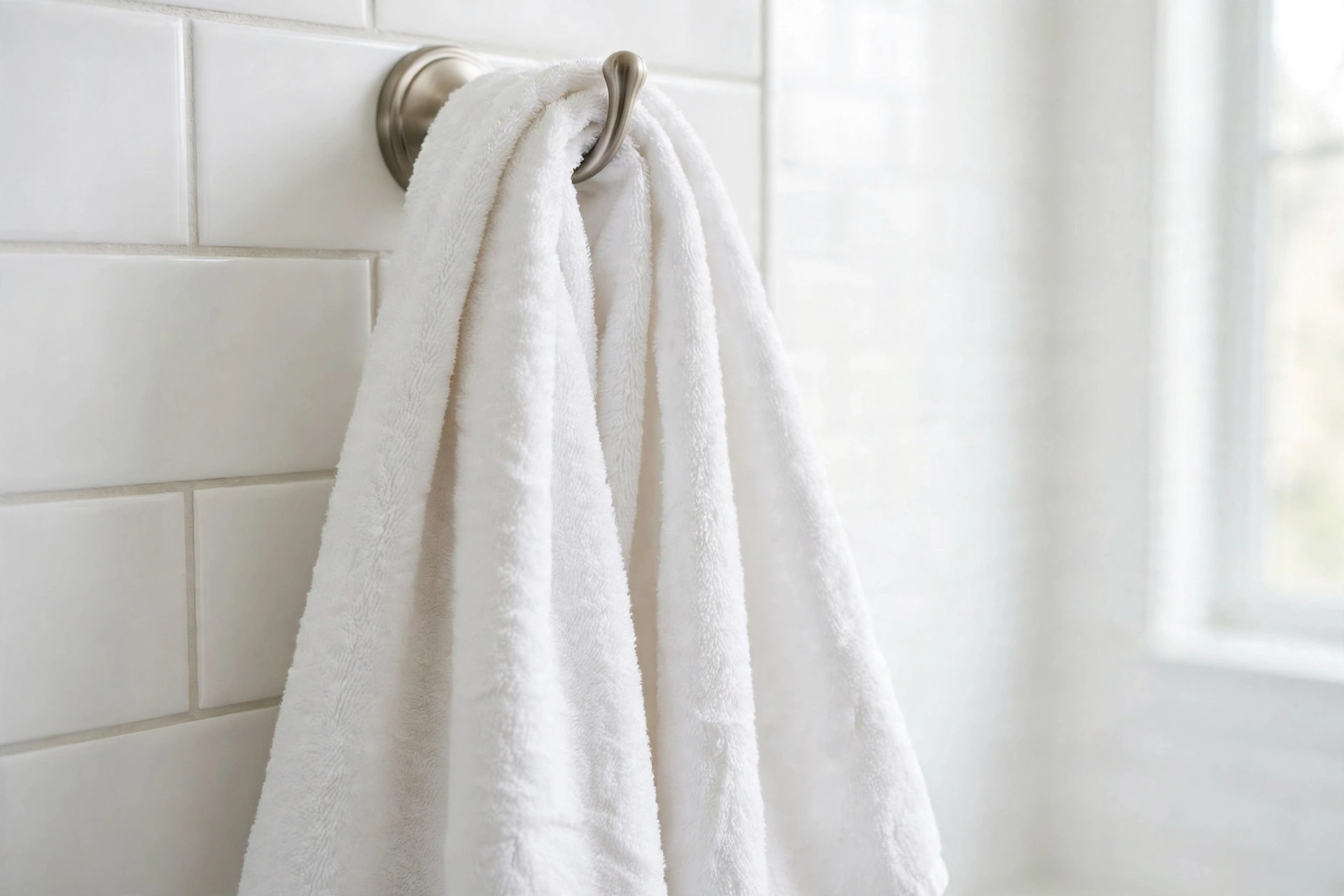
Hooks can look tidy without much effort, as long as every towel follows the same habit. The neat look comes from consistency, not from perfect folding.
- Use the same fold every time. Fold every towel lengthwise in the same way, then drape it evenly over the hook. A row of towels hung the same way reads as intentional; a row hung five different ways reads as clutter.
- Match the towels, or at least the fold. Matching towels help, but a consistent fold and even hanging lengths matter more than matching colours.
- Keep hooks level and evenly spaced. Hooks in a row should sit at the same height and the same spacing apart. Uneven hooks make even neatly hung towels look crooked.
- Leave one hook empty in a guest bathroom. An empty hook signals where a guest’s towel goes and stops towels ending up on the floor or over the shower door.
- Put the neatest towels where guests see them. Folded, evenly draped towels on the most visible hooks, and everyday towels on hooks nearer the shower, keeps the bathroom looking finished without extra work.
For neat-looking wall-mounted storage, see the best wall-mounted towel hooks.
Hooks for Kids, Guests, and Small Bathrooms
Hooks are at their best in exactly the bathrooms where bars struggle: small rooms, children’s bathrooms, and rentals. Children rarely fold a towel neatly over a bar, but they will drape one over a low hook they can reach — and a hook they can reach is the difference between a towel on the wall and a towel on the floor.
In a small bathroom, a staggered pair of hooks — one higher, one lower — fits a narrow wall where a bar will not. In a rental, adhesive or over-the-door hooks give the same hanging routine with no drilling, provided heavy, soaking-wet bath towels go on screw-mounted hooks where possible, since adhesive hooks suit lighter loads best. For the full install method, including anchors, studs, and tile, see our step-by-step guide to installing robe and towel hooks.
For guests, the kindest setup is simple: one clearly free hook near the shower, a hand towel hook near the sink, and no expectation that they fold anything. A guest who can hang a towel in one motion will use the hook; a guest who has to work out a folding routine will leave the towel on the nearest surface.
Mistakes That Keep Towels Damp on Hooks
- Bunching the towel into a ball. The outside dries, the middle stays wet, and the towel smells musty by the next use.
- Stacking two towels on one hook. The towels press together, air cannot reach the touching layers, and neither towel dries properly.
- Hanging towels behind a closed door. Still air is the enemy of drying. Keep the door open or the fan running.
- Letting the towel touch the floor or a countertop. Any contact point stays damp and can pick up dirt.
- Spacing hooks too close together. Towels that overlap dry as slowly as towels stacked on one hook.
- Leaving a wet towel in a laundry basket. A towel left wet in a pile has no airflow at all. Hang it, even imperfectly, rather than leaving it bunched up.
- Hanging a soaking towel on a light adhesive hook. Adhesive hooks suit hand towels and lighter loads; a heavy, soaking bath sheet belongs on a screw-mounted hook.
The fix for almost every one of these is the same routine: shake, fold lengthwise, drape open, one towel per hook, and air moving around it. Get that routine right and hooks do the job well — they save wall space, they are easy for children and guests to use, and they keep towels off the floor, which is the outcome that matters most.