I get this question more than almost any other, usually from someone standing in their half-finished bathroom holding a hook in one hand and a pencil in the other, asking, “Henry, how high should this actually go?” It sounds like a small thing until you’ve drilled a hole eight inches too low and you’re staring at a hole you now have to patch, paint, and explain to your spouse.
Height is the one part of hanging a hook that people rush. They pick a spot that “looks right,” drill, and only later notice the towel drags on the floor, or the robe hook sits so high their kid can’t reach it, or the two hooks they installed side by side are so close together the towels overlap and never dry. None of that is really about the hook itself. It’s about where you put it.
Quick answer: Hang bath towel hooks at 65 inches from the floor (60–70 range), hand towels at 44–48 inches near the sink, robe hooks at 60–66, and kids’ hooks at 36–42. Space hooks 8–10 inches apart, and leave 18–22 inches of clearance above the vanity counter.
Disclosure: This post contains affiliate links. If you buy through them, I may earn a small commission at no extra cost to you.
The height everyone gets wrong
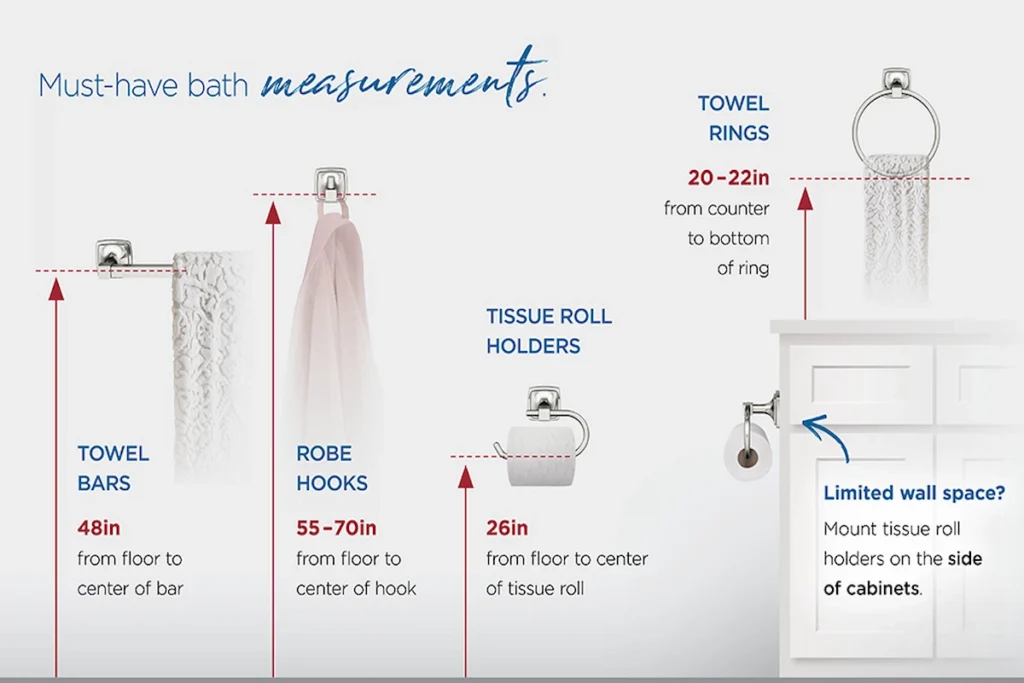
Most people hang bathroom hooks at the standard towel hook height — somewhere between 48 and 55 inches off the floor — without thinking twice, because that’s roughly shoulder height for an average adult. The problem is that a bathroom hook isn’t just decoration, it’s a tool that has to hold a wet towel or robe without letting the bottom edge touch a damp floor, and it has to be reachable by everyone who actually uses that bathroom, including your ten-year-old.
Here’s the range I actually use on jobs, and I’ll be honest that these numbers come from measuring towels and people, not from a design manual:
For a standard bath towel (roughly 30 inches long), I mount the hook between 54 and 60 inches from the floor. That keeps even a fully soaked towel a few inches clear of the tile.
For hand towels near the sink, 44 to 48 inches works well, since you want it low enough to grab quickly but high enough that it clears the counter edge. If you would rather hang hand towels from a ring than a hook, see my roundup of the best towel rings.
For robe hooks, I go a little higher, 60 to 66 inches, mostly because robes are longer and because most adults hang a robe by the collar loop rather than folding it over the hook. For the full mounting process, follow my step-by-step installation guide.
For a kids’ bathroom, drop everything down to 36 to 42 inches. I learned this one the hard way after installing a beautiful row of hooks for a family, at adult height, and getting a call two weeks later asking why their six-year-old kept leaving his towel on the floor. He wasn’t being lazy. He couldn’t reach it.
If you’re deciding between a hook and a full rack, my guide on bathroom towel holder ideas walks through when a holder makes more sense than a single hook, particularly in a shared family bathroom.
Height Above the Vanity / Counter
When you’re working out towel hook height above the vanity, think clearance first: leave 18 to 22 inches between the countertop and the hook, which works out to roughly 50 to 54 inches from the floor in most bathrooms. That gap keeps a hanging hand towel clear of the counter edge, the faucet, and the backsplash, so it dries properly instead of dragging through water. If you’re unsure how high to hang a towel hook above the counter because you have a vessel sink with a tall faucet, hold the towel in place first and test the clearance before you drill.
Heated Towel Rail Height
Heated towel rail height is measured a little differently: mount the unit 42 to 48 inches from the floor to the bottom rail, on the wall closest to the shower so you can grab a warm towel as you step out. Keep it clear of splash zones and follow the manufacturer’s electrical clearances — a heated rail needs a power supply and can’t sit where shower spray hits it directly. See our 2026 heated towel rack picks.
Accessible Bathrooms (ADA Guidance)
The ADA doesn’t set a specific towel hook height, but its 48-inch maximum forward reach is the practical target — that figure is the one people mean when they ask about ADA towel hook height. Mount hooks no higher than 48 inches where wheelchair users need them, and keep the approach clear of the vanity or toilet. In a family bathroom, add a second lower hook rather than lowering everyone’s.
Spacing Matters As Much As Height
When you’re installing more than one hook, the vertical height is only half the job. Towel hook spacing — how far apart you place them — decides whether towels actually dry or just sit in a damp pile against each other.
For double or triple hook setups, leave at least 8 to 10 inches between each hook, centre to centre. Any tighter and you’ll find towels overlapping and staying damp, which in a humid bathroom is exactly how you end up with a mildew smell in the fabric. I’ve re-spaced more “why does my towel always smell a bit off” complaints than I can count, and almost every time the answer was hooks mounted too close together, not a bad towel.
If you’re working with a narrow wall or a small footprint, spacing gets even more important, and I go into specific layouts for tight spaces in my article on small bathroom hook ideas.
Tile, drywall, or the back of a door: the surface changes your plan
Where you’re mounting changes both the height math and the hardware you need.
On tile, I always measure and mark with painter’s tape before drilling, because tile doesn’t forgive a redrilled hole the way drywall does. I aim for the center of a tile rather than a grout line, since grout crumbles under the pressure of a screw anchor over time.
On drywall, you have more freedom, but you still need to hit a stud or use a proper anchor rated for at least 10 to 15 pounds, since a wet towel is heavier than people expect, especially a bath sheet.
On the back of a door, height calculations shift because doors flex slightly every time they open and close, and a rigid screw-in hook can work itself loose over months. This is one of the few spots where I actually prefer a no-drill, tension-mounted hook over a screwed-in one, and I cover exactly which styles hold up in my guide to over-the-door bathroom hooks.
My simple measuring method
I don’t use a laser level for a single hook, that’s overkill. Here’s what I actually do on site, and what I’d tell you to do at home:
First, grab the actual item you’re hanging, whether it’s a bath towel, a robe, or a kid’s towel, and hold it against the wall where you’re thinking of mounting.
Second, mark where the top of the hook would sit so the bottom of the item clears the floor by at least 3 to 4 inches, more if the household tends to overfill the tub and splash the floor.
Third, use a level, not your eye, to make sure the hook sits straight. A hook that’s even slightly tilted becomes obvious the moment you hang something heavy on it.
Fourth, if you’re placing more than one hook, mark all of them before you drill any of them, so you can step back and check the spacing looks even.
Common mistakes I still see on jobs
The single most common mistake is copying a height from a magazine photo without accounting for who actually uses the bathroom. A styled photo doesn’t have a ten-year-old in the house.
The second is mounting at exactly 48 inches because that’s the “accessibility standard” height quoted online, without checking it against the actual length of the towel or robe going on it. Accessibility guidelines are a great starting point for grab bars and fixtures used by someone in a wheelchair, but a decorative towel hook for a family bathroom should be set by the item hanging on it, not a code chart.
The third is ignoring finish and material when picking hardware for a humid room, which matters just as much as height. If you’re deciding between finishes, I break down how brass, chrome, and matte black actually perform in constant moisture in Brass vs Chrome vs Black Bathroom Hooks.
When no-drill is genuinely the smarter choice
Not every bathroom should have a hole drilled in it, especially if you’re renting or not yet fully sure of your final layout. In those cases, a quality adhesive hook, properly prepped and pressed for the full cure time, holds a normal bath towel just fine. I go through which adhesive products actually survive months of shower steam, rather than falling off after a week, in my adhesive towel hooks guide, and I compare wall-mounted screw-in options against them in my wall-mounted towel hooks article.
Adjusting for a household that changes over time
Height decisions get harder when the people using the bathroom aren’t the same age they were when you first installed the hooks. I’ve gone back to the same house three times over a decade as kids grew, moving a low hook up a few inches each visit, and it’s a far cheaper fix than most people expect. Patching one small hole and drilling a new one four inches higher takes me about twenty minutes on a standard drywall or tile wall, so don’t feel locked into a height forever if a growing kid outgrows their hook, or if an ageing parent moving in needs something lower and easier to reach without stretching.
A practical trick I use for households mid-transition is installing two lines of hooks from the start: one at kid height and one at adult height, spaced far enough apart that they don’t visually compete. It costs almost nothing extra during the original install and saves a second round of drilling later.
The short version
Get the height right by measuring the actual towel or robe first, not the wall. Give hooks enough room to breathe so towels dry instead of overlapping. Match your hardware to the surface you’re drilling into, and don’t be afraid to skip drilling altogether if a good adhesive or over-the-door hook does the job just as well. I’ve installed hundreds of these over twelve years, and the jobs that get compliments years later are never the ones with the fanciest hook. They’re the ones where someone took five extra minutes to measure before they drilled.
If your bathroom is on the smaller side and you’re trying to fit hooks, a towel bar, and storage into one wall without it looking cluttered, my guide on small bathroom hook ideas picks up right where this one leaves off.